
Study strategy7-minute readFor pre-meds reviewing the sciences
NMAT Part 2: reviewing biology, chemistry, physics and social science
How to review NMAT Part 2: high-yield areas in biology, chemistry, physics and social science, plus drills and a four-week rotation for fast recall.
Plenty of pre-meds already know their sciences from college and still lose points on NMAT Part 2. The reason is time. This half of the test gives you 120 items in 1 hour 30 minutes, so what you know has to be available in seconds.
This guide covers the four Part 2 subjects one at a time: what to review, a technique for each, and a drill. We describe how to prepare and make no claim about what the test "always" asks. Every example here is our own.
What does NMAT Part 2 measure?
NMAT Part 2 measures academic proficiency in Biology, Physics, Chemistry and Social Science, with 120 multiple-choice items in 1 hour 30 minutes. The Center for Educational Measurement (CEM) defines Social Science as psychology, sociology and anthropology.
Ninety minutes for 120 items is exactly 45 seconds an item. That changes how you review. A concept you can only rebuild from scratch in two minutes is, for test purposes, a concept you do not have yet.
Review in two passes. In the first, make sure you understand how each idea works. In the second, convert that understanding into recall: flash through definitions, formulas and typical examples until they appear on demand.
| Subject | High-yield areas (general) | Drill |
|---|---|---|
| Biology | Cell structure, cell division, genetics, human physiology, evolution and ecology | 15 mixed items, then name the process in each |
| Chemistry | Stoichiometry, periodic trends, bonding, acids and bases, gases, organic functional groups | 10 items with units written out |
| Physics | Kinematics, forces, energy, electricity, waves and optics | Derive the formula, then solve with round numbers |
| Social Science | Major theories and terms in psychology, sociology and anthropology | Term-to-example matching, daily |
How should you review biology for the NMAT?
Review biology by organising it around processes and relationships, not isolated facts, then test yourself with statement-judging items. Biology rewards people who can explain what happens, why, and what changes if one step fails.
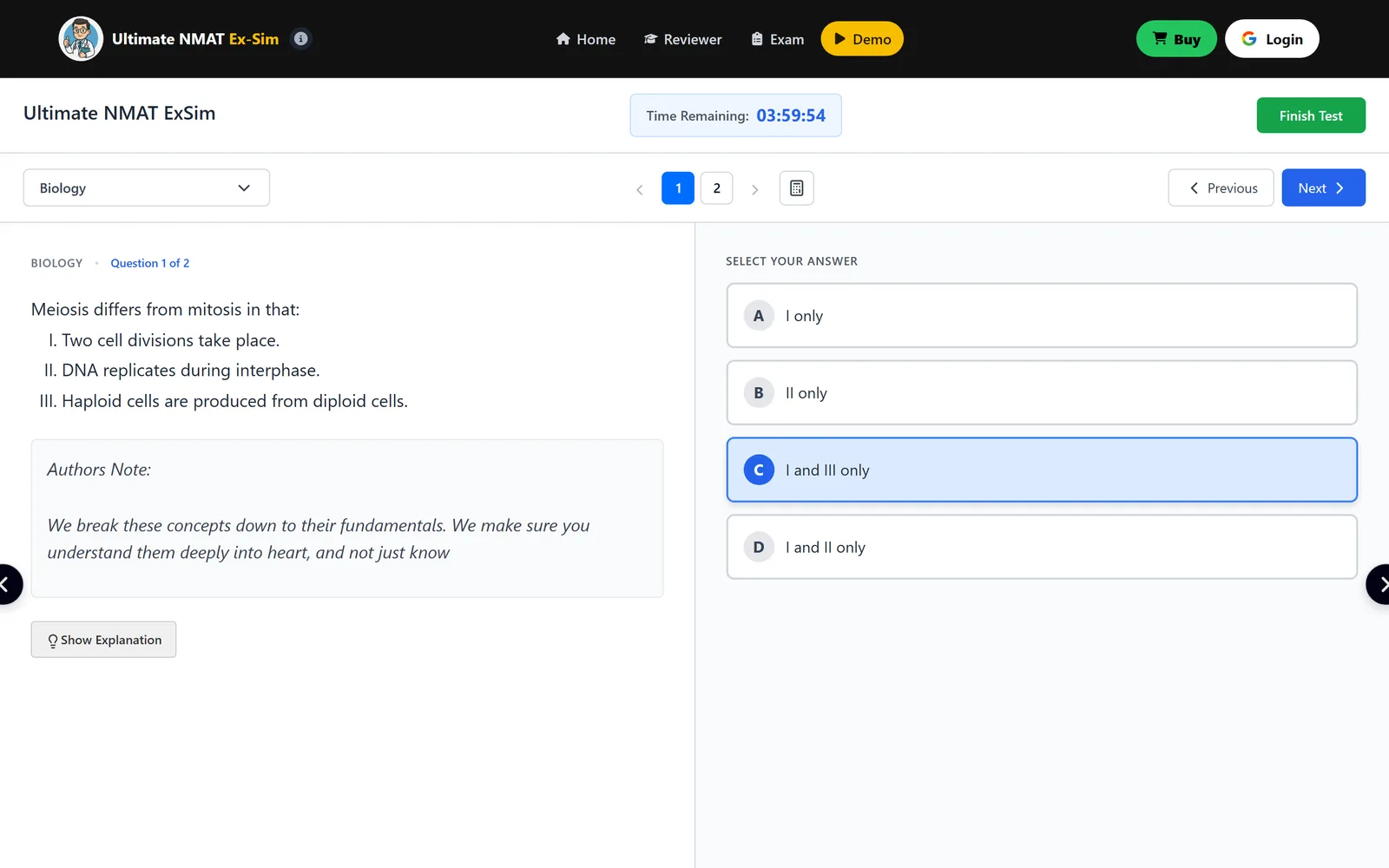
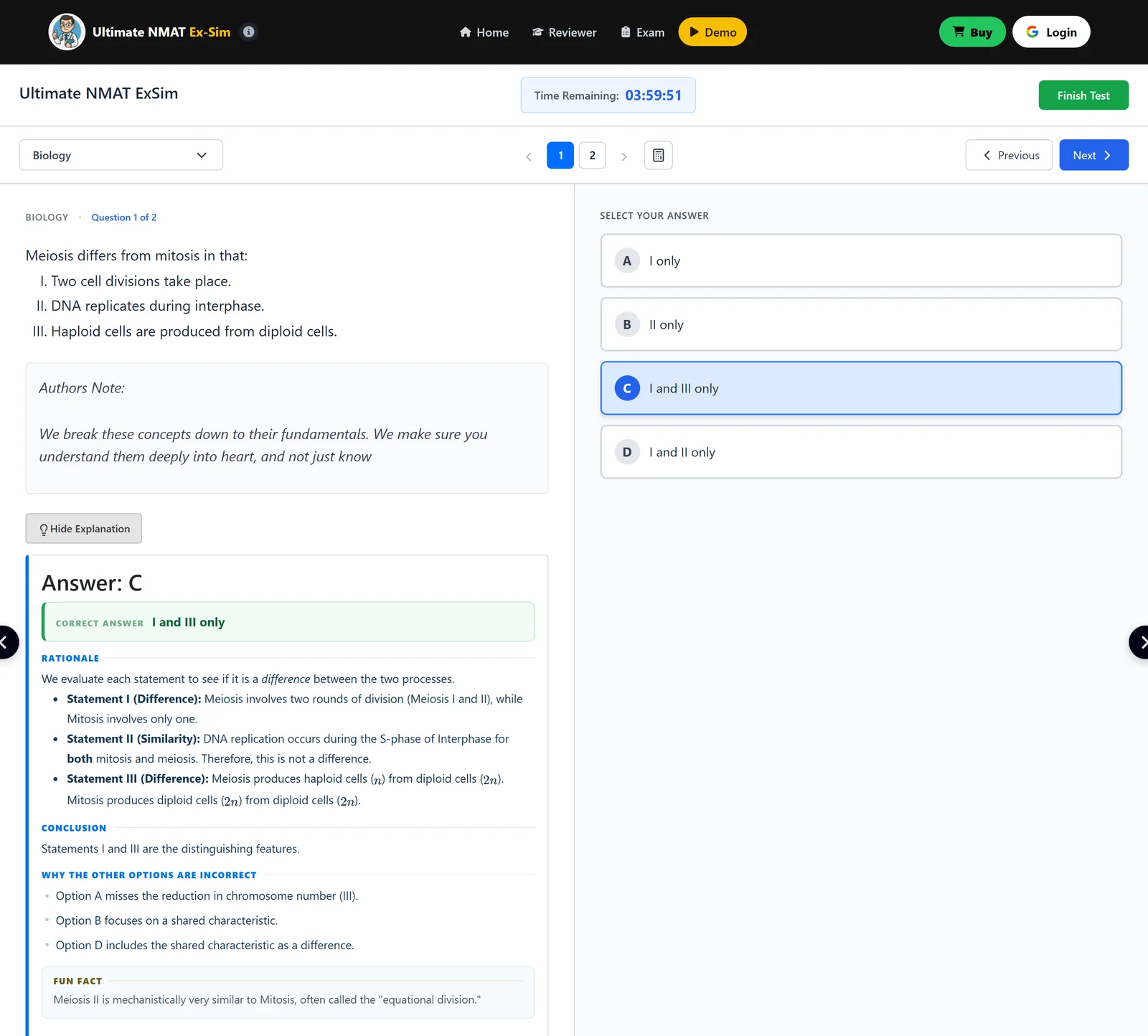
Start with cell structure and division. Meiosis versus mitosis is a good example of the kind of contrast worth knowing cold: meiosis produces four genetically distinct haploid cells through two divisions and includes crossing over, while mitosis produces two identical diploid cells through one division. Then cover genetics, where a cross of two heterozygotes (Aa × Aa) gives a 3:1 ratio of dominant to recessive phenotypes and a 1:2:1 genotype ratio.
Add human physiology by system (circulatory, respiratory, digestive, nervous, endocrine), plus evolution and ecology. For each system, be able to state the structure, its main function, and one thing that goes wrong.
Roman-numeral formats, like the meiosis item in the demo, reward judging each statement separately. Mark each one true or false before you look at the options.
How should you review chemistry for the NMAT?
Review chemistry by mastering a small toolkit of calculations and trends, since many items reduce to a mole ratio, a periodic pattern or an acid–base idea. With 45 seconds an item, you want these to be reflexes.
First, stoichiometry. One mole of water has a mass of 18 g, because hydrogen contributes about 2 g and oxygen about 16 g per mole. So 36 g of water is 2 mol. Practise moving between grams, moles and particles without hesitation.
Second, periodic trends: atomic radius, electronegativity and ionisation energy, and why each rises or falls across a period and down a group. Third, acids and bases. A 0.001 M solution of a strong monoprotic acid such as HCl has a pH of 3, because pH is the negative logarithm of the hydrogen-ion concentration, and 0.001 is 10⁻³.
Finish with gas relationships, bonding and shape, and the main organic functional groups: alcohol, aldehyde, ketone, carboxylic acid, amine and ester. A one-page chart of names, structures and a characteristic property is a high-return review tool.
How should you review physics for the NMAT?
Review physics by learning each core formula together with its meaning and units, then solving with round numbers you can handle mentally. Physical calculators are prohibited on test day, so a problem that looks heavy usually has an easy path.
Take kinematics. A car starting from rest and accelerating at 2 m/s² for 5 s reaches a speed of 2 × 5 = 10 m/s and covers ½ × 2 × 5² = 25 m. Forces follow from Newton's second law, F = ma, so a 3 kg mass accelerated at 4 m/s² needs 12 N. Electricity starts from Ohm's law: 12 V across a 4 Ω resistor drives I = V/R = 3 A.
Add work and energy, momentum, simple circuits, waves, sound, light and basic optics. For each formula, ask what happens if one variable doubles. That habit builds the estimation ability that saves seconds.
The reviewer includes a physics simulation lab where you can change values and watch what happens. Try a few of them to turn formulas into intuition.

How should you review social science for the NMAT?
Review social science by building a glossary of terms across psychology, sociology and anthropology, and attaching a concrete example to each term. CEM includes these three fields under Social Science in Part 2, and it tests concepts and vocabulary more than calculation.
In psychology, cover the major perspectives, learning and conditioning, memory, development, and the biological basis of behaviour. In sociology, cover social structure, groups and institutions, socialisation, stratification, deviance and social change. In anthropology, cover culture, kinship, subsistence, and the methods anthropologists use, such as ethnography.
Examples make terms stick. "Operant conditioning" becomes a child who tidies a room to earn a reward. "Socialisation" becomes a new student learning the unwritten rules of a school.
A spaced routine works well here because the content is wide. Ten minutes with your term list daily, plus one short timed set a week, keeps it fresh without taking study time from physics and chemistry, where calculation speed needs more repetition.
What does a four-week Part 2 rotation look like?
A four-week rotation puts one science in the spotlight each week while the others get light maintenance, and then repeats with the weakest subject first. This keeps all four warm and still gives depth.
| Week | Spotlight | Maintenance | End-of-week check |
|---|---|---|---|
| 1 | Biology | 15 min a day on each other subject | 30-item timed mixed set |
| 2 | Chemistry | 15 min a day on each other subject | 30-item timed mixed set |
| 3 | Physics | 15 min a day on each other subject | 30-item timed mixed set |
| 4 | Social Science plus your weakest subject | 10 min a day on the rest | One full 120-item Part 2 block, timed |
Aim your checks at pace: 30 items should take about 22 minutes and 30 seconds at 45 seconds each. Missed items go into an error log with the reason, a topic to review or a slip. Our question review method explains how to keep that log, and the eight-week study plan shows how this rotation fits with Part 1 work from our Part 1 guide. To sample all four sciences on a clock, try the free demo.
Frequently asked questions
Which science should I prioritise for NMAT Part 2?
Prioritise the one where a timed baseline loses the most points, since that is where an extra hour pays most. Do not assume one science is more valuable than another. Take a timed set across all four, compare your accuracy and speed, and then give your weakest subject the biggest share of the rotation.
Is social science tested on the NMAT?
Yes. CEM lists Social Science as part of Part 2, covering psychology, sociology and anthropology. Treat it as a concepts-and-terms subtest. Build a glossary, attach an example to each term and review it in short daily sessions rather than leaving it for the last week.
How long is NMAT Part 2?
Part 2 has 120 items and lasts 1 hour 30 minutes, which is 45 seconds an item on average. It follows a 10-minute break after Part 1, which has 120 items in 2 hours 15 minutes. Practise at the 45-second pace early, because recall under that clock feels different from untimed review.
Can I use a calculator in physics and chemistry items?
No physical calculator is allowed on test day, according to CEM's test-day instructions. Practise with round numbers, powers of ten and simple fractions, and write units alongside every step. Check CEM's current instructions before your sitting for the full list of rules on materials.
Sources
From the publisher
Meet the NMAT clock here first.
Ultimate NMAT is an NMAT simulator: full-length practice exams and subtest drills in all eight NMAT subtests, sat on a clock, with an explanation behind the items instead of a bare answer key.
- 4,670 practice items in all eight NMAT subtests
- nine full-length practice exams (A to I), 2,320 items
- eight subject drill tracks of ten sets each, 2,350 items
- An interactive reviewer and simulation lab beside the question bank
Try the free NMAT simulator demo A short sample in all eight subtests. No account needed.
About this article
Written by the Ultimate NMAT editorial team, who build the Ultimate NMAT Ex-Sim. Exam facts are checked against the Center for Educational Measurement (CEM) test pages and the CHED issuances CEM cites, and every article lists its sources. How we write and check our articles.
First published .