
Guides7-minute readFor pre-meds who practise a lot but plateau
How to review NMAT practice questions so your percentile actually moves
A method for reviewing NMAT practice questions: commit first, read explanations, log each error by type, drill by subtest and keep a weekly rhythm.
If you have done hundreds of NMAT practice questions and your results have stopped moving, the problem is rarely effort. It is usually what happens after you answer. This guide gives a four-step method for reviewing mistakes, a table that sorts them by type, and a weekly rhythm you can start today.
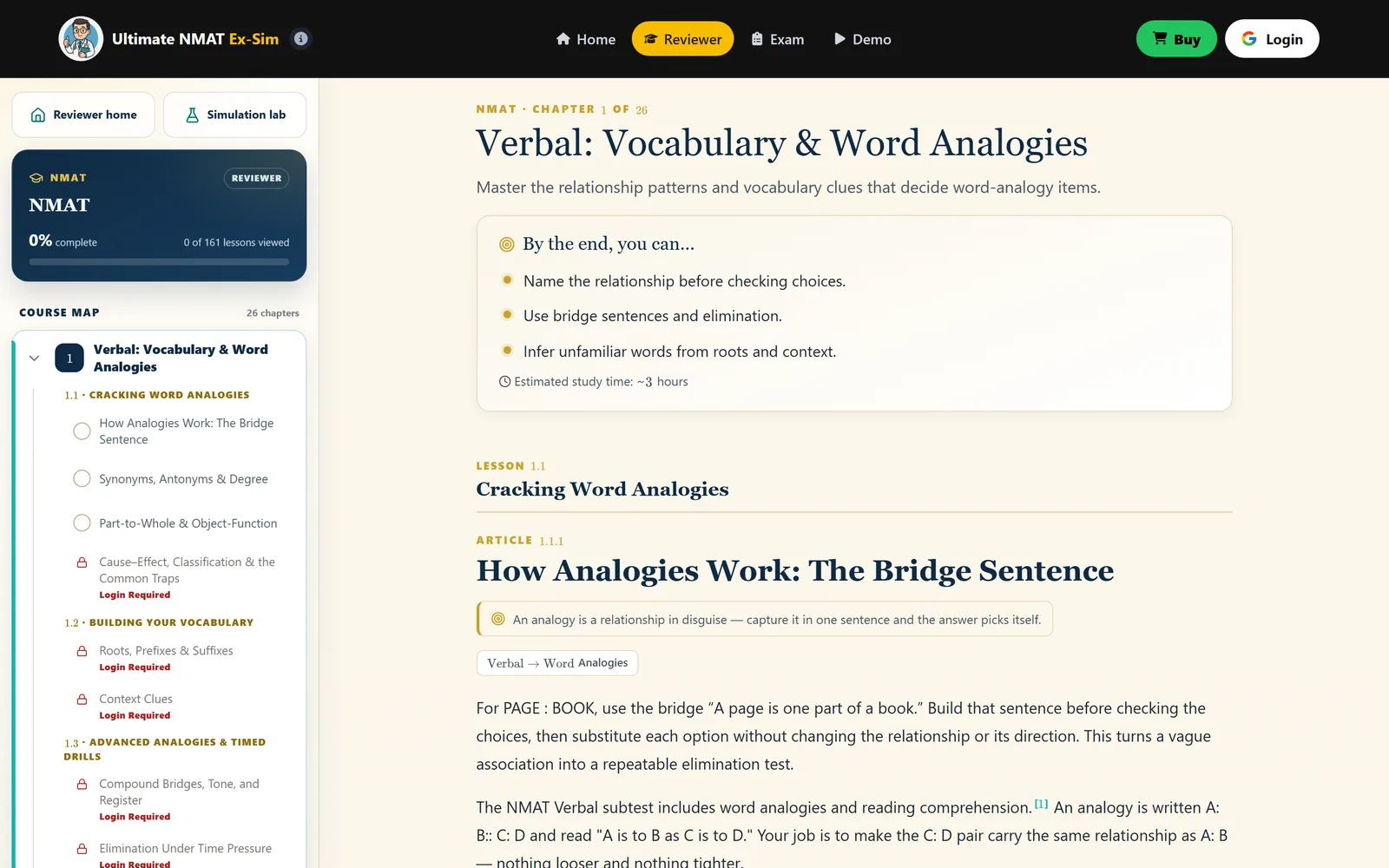
Ultimate NMAT, which publishes this blog, makes a simulator with explanations, so the method uses that kind of material. It works equally well with a book that has an answer key, as long as you do the logging yourself.
Why does volume alone plateau?
Volume alone plateaus because answering a question and learning from it are different acts. If you finish a set, glance at your score and move on, the mistakes that cost you points stay in place, and the next set repeats them.
The test makes this costly. The Center for Educational Measurement (CEM) describes the Online NMAT as 240 multiple-choice items in two parts of 120, over eight subtests. A habit that costs you three items in each subtest, such as misreading "not" in a stem, is 24 items you give away every sitting.
There is also a comfort trap. Doing more questions feels productive, and a long streak of practice hides how little you reviewed. A useful rule: for every hour spent answering, plan at least half an hour on review. If that sounds like too much, do fewer questions and review them properly. Twenty reviewed items beat sixty skimmed ones.
Why should you commit to an answer first?
Commit to an answer before you look at the key, because a committed answer is data and a peek is not. If you read the explanation first, everything looks obvious in hindsight and you learn nothing about what you actually knew.
Committing has three levels worth recording:
- Sure and right. Move on; spend no time here.
- Guessed and right. Treat as a miss. Luck does not repeat on test day.
- Wrong. Log it, whether you were sure or not. A confident wrong answer is the most valuable item in the set, because it is a false belief.
In a timed setting, commit as you would on the real test: choose, move on, and only afterwards return to what you flagged. Part 1 gives about 67.5 seconds an item and Part 2 gives 45, so there is no time to ponder, and your review habits should match.
How should you read an explanation?
Read an explanation for the reasoning, not the answer. The letter tells you nothing you can reuse; the logic is what transfers to the next item.
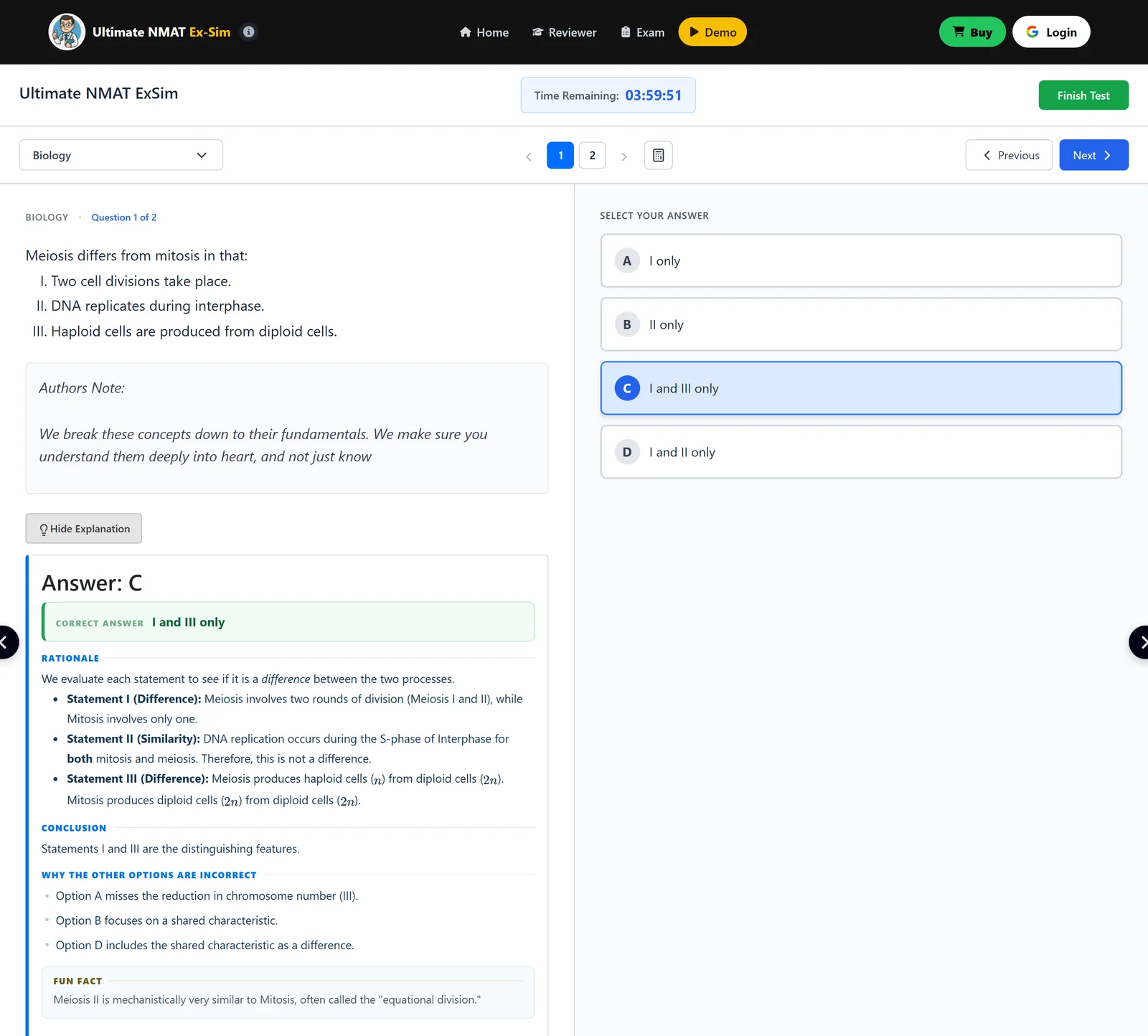
A useful explanation has three parts, and you should look for each. First, why the correct option is correct, in steps. Second, why each wrong option fails, because the distractors show you the traps. Third, the underlying idea, which you can state in one sentence. In the demo item below, a Biology question on meiosis, the explanation works through the statements one by one and then explains the other options.
After reading, close the explanation and restate the idea in your own words. If you cannot, you have not learned it yet. If the gap is content, go to a reviewer chapter such as the ones at /learn/, then come back to a similar item. Explanations accompany most of the 4,670 items in Ultimate NMAT, but not all, so for the rest you will need your reviewer or a worked solution of your own.
How do you keep an error log for NMAT practice questions?
Keep an error log with one line per miss: the subtest, the item, the error type and the fix. A spreadsheet or a notebook both work. The log turns scattered mistakes into patterns.
Classify each miss into one of four types. The table shows how to recognise each and what to do.
| Error type | Sign | Fix |
|---|---|---|
| Content | You did not know the idea, or could not recall it | Rebuild it from a reviewer, then redo similar items |
| Speed | You knew it but ran out of time, or took far longer than the pace | Drill the subtest on a timer; learn when to skip |
| Misread | You answered a different question, such as missing "not" or "except" | Underline the question word before reading options |
| Careless arithmetic | The method was right but a step was wrong | Write each step; check by estimation |
After two weeks, count the log by type and by subtest. If half your misses are misreads, more content review will not help. If most are content errors in Chemistry, more Verbal practice will not help either.
Arithmetic matters in particular because physical calculators are prohibited on test day. Practise by hand so that your errors reflect test conditions.
How do you drill by subtest?
Drill the subtest your log points to, in short timed sets, until its error rate drops. CEM lists eight subtests: Verbal, Inductive Reasoning, Quantitative and Perceptual Acuity in Part 1, and Biology, Chemistry, Physics and Social Science in Part 2.
A drill session has a clear shape: ten to twenty items from one subtest, with a timer set to the part's pace, followed by review. Ultimate NMAT has eight drill tracks of ten sets each, 2,350 items, built for this. The point is the isolation. A weak Inductive Reasoning is hard to repair inside a full exam, where it is buried among other results.
Then re-test. A fix is only a fix if the same kind of item goes right a week later. For Part 1 patterns and speed, see our guide to training the mental-ability subtests. Rotate subtests rather than grinding one for a week, so the others do not decay.
What does a weekly rhythm look like?
A workable week has three kinds of session: drills, one timed part, and a review block. The pattern repeats, and the log steers it.
| Day | Session | Length | Output |
|---|---|---|---|
| Mon | Drill: weakest subtest | 45 min | Log updated |
| Tue | Content repair from the reviewer | 60 min | Notes on two ideas |
| Wed | Drill: second weakest subtest | 45 min | Log updated |
| Thu | Rest or light recall | 20 min | None |
| Fri | Drill: mixed, timed | 45 min | Log updated |
| Sat | One timed part (Part 1 or Part 2) | 2 h 15 min or 1 h 30 min | Full review the same day |
| Sun | Review log, plan the next week | 30 min | Next week's focus |
Keep review in the same day as the timed part, while the reasoning is fresh. Once every few weeks, replace Saturday with both parts and the 10-minute break, which is the full-length rehearsal. The 8-week study plan places those rehearsals on a calendar, and NMAT reviewer vs simulator explains how the two tools divide the work. You can try the method on the free demo, which has 19 items across all eight subtests.
Frequently asked questions
Should I read explanations for questions I got right?
Yes, at least for the ones you were unsure about or guessed. A lucky correct answer hides a weak idea. Skim the explanation for sure-and-right items; read it properly for anything that was a guess, since the same idea may appear in a different form on test day.
How many practice questions should I do a day?
There is no official number. A sensible range is 20 to 40 reviewed items on a normal day, adjusted to your schedule. Online administrations are typically scheduled in October to November, January to February and April to May, so set your daily target by the weeks you have left before your window. Quality matters more than quantity, so if reviewing takes longer than answering, you are doing it correctly. Reduce the count before you reduce the review.
Should I use drills or full exams?
Use both, in sequence. Drills isolate and repair a weak subtest; full exams test pace and stamina across both parts. Early in preparation, lean on drills. In the last few weeks, shift towards full exams in the real order, with the break.
Do I need an explanation for every question?
It helps, but you can cover gaps yourself. Where an item has no explanation, write the reasoning in your own words, check it against a reviewer, and log the idea. The habit of explaining is worth more than any one explanation.
Sources
From the publisher
Meet the NMAT clock here first.
Ultimate NMAT is an NMAT simulator: full-length practice exams and subtest drills in all eight NMAT subtests, sat on a clock, with an explanation behind the items instead of a bare answer key.
- 4,670 practice items in all eight NMAT subtests
- nine full-length practice exams (A to I), 2,320 items
- eight subject drill tracks of ten sets each, 2,350 items
- An interactive reviewer and simulation lab beside the question bank
Try the free NMAT simulator demo A short sample in all eight subtests. No account needed.
About this article
Written by the Ultimate NMAT editorial team, who build the Ultimate NMAT Ex-Sim. Exam facts are checked against the Center for Educational Measurement (CEM) test pages and the CHED issuances CEM cites, and every article lists its sources. How we write and check our articles.
First published .