
Study strategy8-minute readFor pre-meds weak in reasoning subtests
NMAT Part 1: how to train the mental-ability subtests
A practical guide to NMAT Part 1: how to train Verbal, Inductive Reasoning, Quantitative and Perceptual Acuity with patterns, techniques and weekly drills.
If you search for NMAT Part 1 tips, you will find a lot of advice about content. Part 1 is mostly not about content. It is about how quickly and cleanly your head handles words, patterns, numbers and shapes, and that is something you can train.
This guide covers the four Part 1 subtests one by one: what each asks you to do, a technique that works, and a drill you can run in ten minutes. Every example item below is our own, written to teach a method. We make no claim about what the test will ask on any given day.
What does NMAT Part 1 measure?
NMAT Part 1 is the mental-ability half of the test: 120 multiple-choice items in 2 hours 15 minutes, covering four subtests. The Center for Educational Measurement (CEM) lists them as Verbal, Inductive Reasoning, Quantitative and Perceptual Acuity, and treats Part 2 as the academic-proficiency half.
Those 135 minutes work out to an average of about 67.5 seconds an item. An average hides the real picture. A perceptual item may take ten seconds and a reading passage three minutes, so you bank time on quick items and spend it on slow ones.
Because Part 1 is not memory work, you cannot cram it. A short daily drill beats a weekend marathon, which is why the plan later in this post is built from small, repeatable blocks.
| Subtest | What it covers (per CEM) | Core skill | Daily drill |
|---|---|---|---|
| Verbal | Word analogies, reading comprehension | Naming relationships, finding the main point | 10 analogies and 1 short passage |
| Inductive Reasoning | Number, letter and figural series | Spotting the rule behind a sequence | 8 series, rule written after each |
| Quantitative | Fundamental operations, problem solving, data interpretation | Mental arithmetic and setting up problems | 10 minutes of no-calculator sums |
| Perceptual Acuity | Hidden figures, mirror images, identical information | Fast, accurate visual comparison | 5 minutes of timed matching |
How do you train the Verbal subtest?
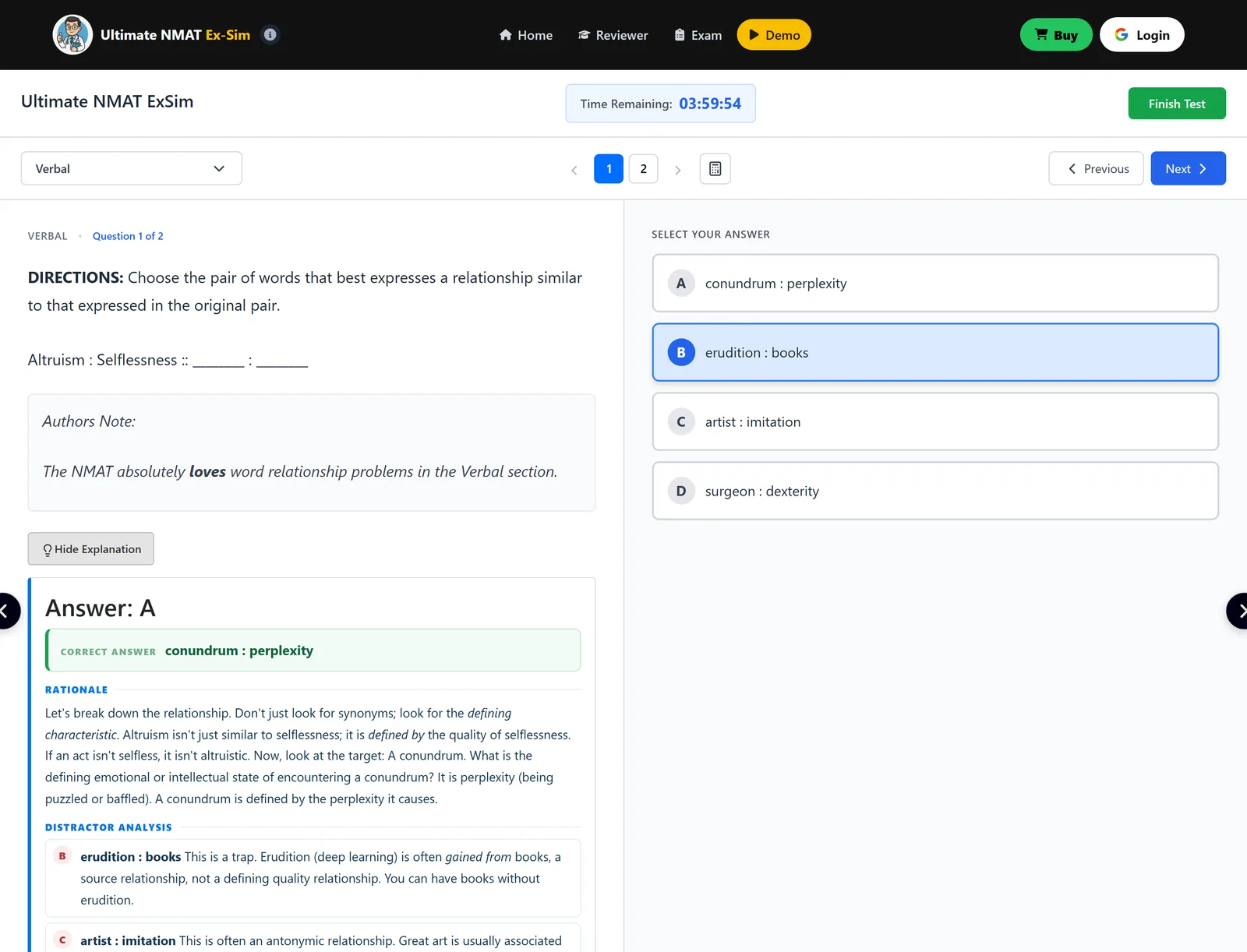
Train Verbal by naming the relationship in an analogy before you read the options, and by reading passages for structure rather than detail. Verbal covers word analogies and reading comprehension, and both reward two seconds of deliberate thought before you commit.
Take our own example: thermometer : temperature :: barometer : ? The bridge sentence is "a thermometer measures temperature", so the answer must be what a barometer measures, which is atmospheric pressure. An option such as "wind" is another weather idea, but it does not fit the same relationship.
For passages, read the first and last sentence of each paragraph, then the question, then the text. Ask what the author wants you to conclude. Wrong options often quote the passage accurately but answer a different question.
Build vocabulary from your own misses. When an unknown word appears in an analogy, add it to a running list with a one-line meaning and review the list for five minutes each evening.
How do you train Inductive Reasoning?
Train Inductive Reasoning by testing every series against the same short list of rules, in the same order, and writing the rule down once you find it. The subtest covers number, letter and figural series, and a fixed checklist stops you from staring at a sequence and hoping.
Use this order: constant difference, growing difference, constant multiplier, alternation, then a combination. Here are three examples of our own:
- 3, 6, 12, 24, ? Each term doubles, so the next term is 48.
- 2, 5, 9, 14, 20, ? The gaps are 3, 4, 5, 6, so the next gap is 7 and the answer is 27.
- B, D, G, K, ? The letters are numbered 2, 4, 7, 11 with gaps 2, 3, 4, so the next gap is 5, giving 16, which is P.
Alternation hides well. In 5, 2, 10, 4, 20, 8, ? the odd positions double (5, 10, 20) and the even positions double (2, 4, 8), so the seventh term is 40. Write the gaps down every time. It takes two seconds and prevents the slip that mental counting invites.
How do figural series work?
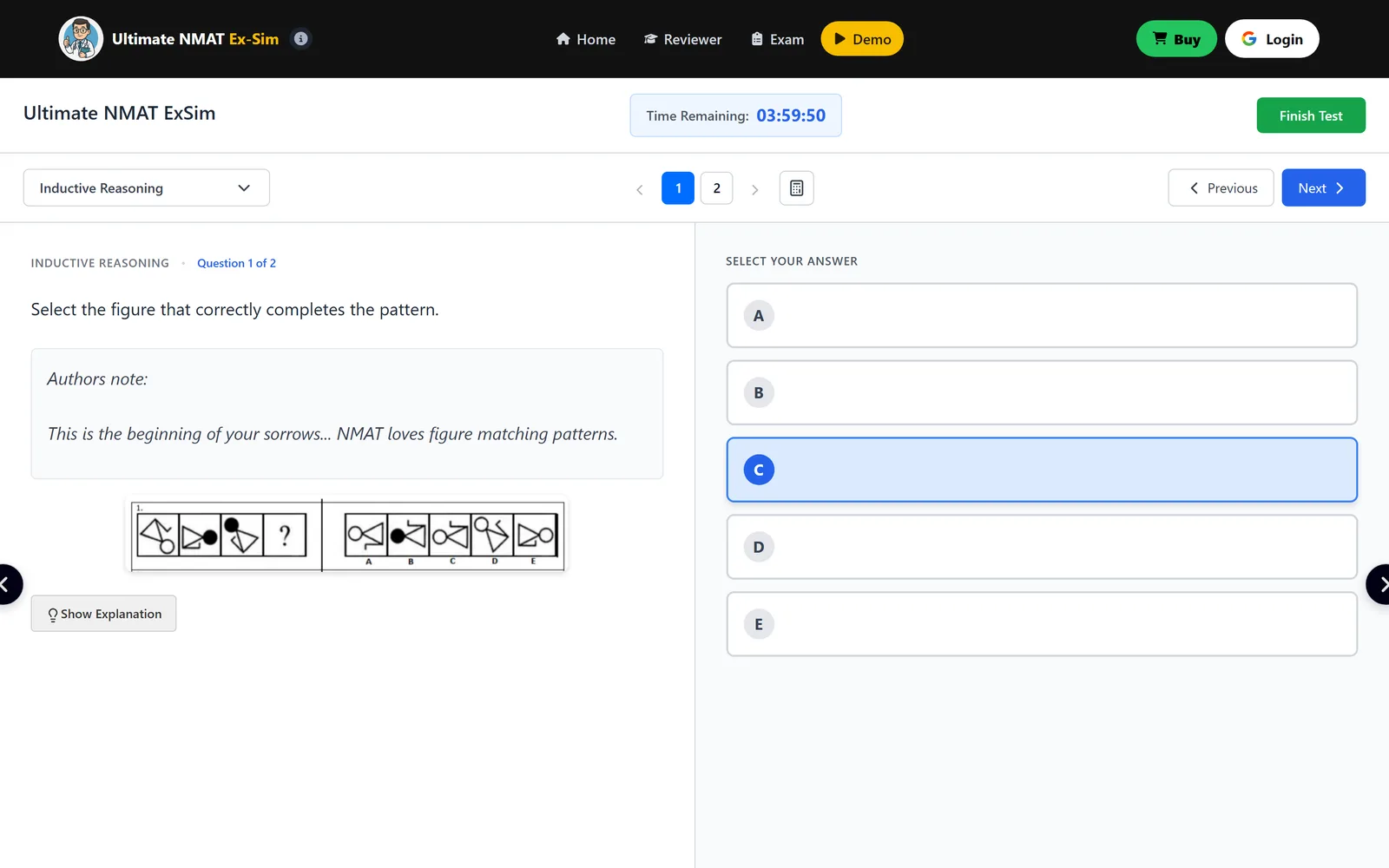
Figural series work like number series, except that you track what changes in each step: position, rotation, shading, size or count. The image in the stem is part of the item, and in the Ultimate NMAT demo the figures appear in the question itself, followed by lettered candidates.
Make a small table in your head with one row per property. Does the shaded part move clockwise by one place each step? Does the number of sides grow by one? Does a small mark flip every second figure? Check one property at a time, find which candidate keeps all the rules, and cross out candidates as soon as one rule breaks.
Two habits save time. First, test the property that changes most obviously, because it eliminates the most candidates. Second, check the step between the last two shown figures first, since the answer continues from there. Practise by drawing your own four-figure series on paper, then asking a friend to find the rule.
How do you train Quantitative without a calculator?
Train Quantitative by building mental arithmetic until common sums take no thought, then practising setting up word problems cleanly. CEM lists fundamental operations, problem solving and data interpretation, and physical calculators are prohibited on test day.
So the skill is speed with fractions, percentages, ratios and estimation. For example, 15% of 240 is 10% (24) plus 5% (12), which is 36. Doing that in three seconds frees time for the harder items.
For data interpretation, read the title, axes and units before the question. Many errors come from reading thousands as units or ignoring a percentage axis. Circle the unit in your mind, then calculate.
We cover the techniques, a fraction-to-percent table and checked worked examples in our guide to NMAT quantitative without a calculator. Start there if arithmetic is your weak point, then return here to fit it into a Part 1 routine.
How do you train Perceptual Acuity?
Train Perceptual Acuity with short, timed matching drills and a consistent scanning method, and expect speed gains from practice without assuming any particular result. CEM describes this subtest as hidden figures, mirror images and identical information.
For hidden figures, find the most unusual feature of the target shape, such as a sharp angle or a closed loop, then scan the larger figure for that feature rather than for the whole shape. For mirror images, decide the mirror line first. A left-right reflection swaps left and right but leaves top and bottom unchanged, so check one distinctive corner and eliminate on that. For identical information, compare strings in chunks of two or three characters, always in the same direction.
Because accuracy suffers when you rush, set a gentle clock. Five minutes of timed matching each day, followed by checking your errors, is enough to show whether you are faster and still accurate.
What does a weekly Part 1 drill plan look like?
A good weekly plan gives every Part 1 subtest a small daily slot, adds one longer timed block, and ends with a review of errors. Here is a template of about 45 minutes on weekdays that you can adjust to your schedule.
| Day | Block | Focus |
|---|---|---|
| Monday | 15 min + 15 min | Verbal analogies, then a series set |
| Tuesday | 20 min + 10 min | No-calculator arithmetic, then perceptual matching |
| Wednesday | 15 min + 15 min | Reading passage, then hidden figures |
| Thursday | 20 min + 10 min | Data interpretation, then mirror images |
| Friday | 30 min | Mixed Part 1 drill set under a clock |
| Saturday | 60 min | Timed Part 1 block, then error review |
| Sunday | Rest or 15 min | Review the vocabulary list |
Record your result for each block, with time and score. After three weeks you will see which subtest still costs you the most seconds. The Ultimate NMAT demo lets you try each subtest on a clock before you commit to a routine, and our time management guide shows how to pace the whole part. Part 2 asks for a different kind of work, covered in our Part 2 science guide.
Frequently asked questions
Can you study for perceptual acuity?
Yes, in the sense that timed practice builds familiarity and speed with hidden figures, mirror images and identical-information items. We cannot promise a particular gain, because people differ. What helps most is a consistent scanning method, a short daily clock and a habit of reviewing errors to see whether they came from rushing or from missing a feature.
Which Part 1 subtest is hardest?
It depends on the person, and we do not claim that one subtest is harder for everyone. A reader who loves words may find series tedious, while someone strong in arithmetic may find reading passages slow. A baseline timed set in all four subtests shows where your seconds go and which one to train first.
How long is NMAT Part 1?
Part 1 has 120 items and lasts 2 hours 15 minutes, according to CEM. That is an average of about 67.5 seconds an item. A 10-minute break follows before Part 2, which has 120 items in 1 hour 30 minutes. Pace yourself by subtest, because some items take far less than the average.
Do I need a calculator for Quantitative?
You should not plan on one. CEM lists physical calculators among the items prohibited during the online test, so build mental arithmetic, estimation and clean written setups. Check the current Test Day Instructions before your sitting for the exact rules on scratch work and materials.
Sources
From the publisher
Meet the NMAT clock here first.
Ultimate NMAT is an NMAT simulator: full-length practice exams and subtest drills in all eight NMAT subtests, sat on a clock, with an explanation behind the items instead of a bare answer key.
- 4,670 practice items in all eight NMAT subtests
- nine full-length practice exams (A to I), 2,320 items
- eight subject drill tracks of ten sets each, 2,350 items
- An interactive reviewer and simulation lab beside the question bank
Try the free NMAT simulator demo A short sample in all eight subtests. No account needed.
About this article
Written by the Ultimate NMAT editorial team, who build the Ultimate NMAT Ex-Sim. Exam facts are checked against the Center for Educational Measurement (CEM) test pages and the CHED issuances CEM cites, and every article lists its sources. How we write and check our articles.
First published .