
The NMAT explained7-minute readFor applicants decoding their NMAT result
The NMAT percentile explained: what your rank means for medical school
What an NMAT percentile rank means, why there is no passing score, how schools and CHED set the requirement, and how long your result stays valid.

Applicants search for an "NMAT passing score" every year, and the honest answer is that there is none. The National Medical Admission Test is an admission test, and its result is a percentile rank. What matters is the percentile that your medical school, or the Commission on Higher Education (CHED), requires.
This post explains what an NMAT percentile is, how it differs from a score out of 240, how the requirement is worded by the Center for Educational Measurement (CEM), and how to find the number that applies to you. We do not quote a minimum, because the source we rely on does not give one.
What is a percentile rank?
A percentile rank is a statement of relative standing: it tells you what share of a comparison group you equalled or beat. If a test reports you at the 70th percentile, roughly 70 out of 100 people in the comparison group scored at or below you. It does not say you answered 70 percent of the items correctly.
That difference trips up many applicants. A percent-correct figure depends only on your answers. A percentile depends on everyone else's answers too, so the same raw performance can sit at a different percentile when the comparison group changes.
| Concept | What it means | What to do with it |
|---|---|---|
| Percent correct | Share of items you answered correctly | Use it to track your own practice |
| Percentile rank | Your standing relative to other examinees | Compare it with your school's requirement |
| Cut-off | The percentile a school or CHED requires | Ask each school for its current figure |
The 70 above is only an illustration of how to read a percentile. It is not an NMAT benchmark.
Is there a passing score on the NMAT?
No. The NMAT does not have a pass or fail mark. CEM runs it as an admission test, whose aim is to upgrade the selection of applicants to Philippine medical schools (CEM, Background of the NMAT). It ranks applicants. It does not certify them.
This is why articles that give one "passing percentile" for the whole country should make you cautious. The rule that CEM states is conditional, and the condition depends on the school. We cover the wording in the next section.
One more reason the question has no single answer: schools differ in how competitive they are. A school with many more applicants than places can ask for a higher percentile than the Commission's requirement alone. Another may sit closer to it. Either way, you are not "failing" the NMAT by landing below a number. You are failing to meet one school's entry requirement, and you may still meet another's.
How do schools and CHED use the percentile?
The requirement is a percentile score equal to or higher than the one currently prescribed by the school or the Commission, whichever is higher. CEM's eligibility page words it this way: the NMAT must be taken not more than two years from the time of admission, with a percentile score equivalent to or higher than that prescribed by the school or the Commission, whichever is higher (CEM, Eligibility and Registration Requirements).
Read it in two steps:
- CHED prescribes a percentile for medical school admission.
- A school may prescribe a higher one, and if it does, the higher number is yours to meet.
So the Commission's figure works as a floor, and the school's figure is the one that decides your application. We do not state the Commission's number here because CEM's page does not publish it, and the figures that circulate online come from sources we could not verify. Ask the admissions office, and check the Medical Schools Directory that CEM links from its NMAT home page.
How long is an NMAT result valid?
Your NMAT must be taken not more than two years before the time of admission to medical school (CEM, Eligibility and Registration Requirements). That is a rule about when you sat the test relative to when you are admitted.
Count forward from your test date to the start of the term you are applying for, not to the date you submit your application. If you test early in your last year of college and your admission is two intakes away, you have more margin than you may think, but check the arithmetic against your target school's entry date.
Validity also shapes timing choices. A very early sitting can expire before you enter, and a late sitting can miss an application deadline. We cover windows and deadlines in our post on the NMAT schedule and results.
CEM's eligibility page also lists applicants who failed to reach a school's cut-off, and those with valid eligibility who want to improve their scores, among those who may take the test. If you are in that position, our guide to retaking the NMAT covers how to plan the next attempt.
What counts as a good NMAT percentile?
A good percentile is one at or above what your target school requires, and that figure varies by school. There is no universal "good" number in any source we can cite, so the only meaningful target is your own list of schools.
A workable method:
- List three to five schools you would accept.
- Ask each admissions office for its current NMAT percentile requirement and how it treats applicants near the line.
- Take the highest of those figures as your working target.
- Treat that target as a goal for practice, not a prediction.
The image below shows a Verbal item from our demo. Practice items like this give you accuracy and speed data, but they cannot give you a percentile, because a percentile needs the real comparison group. No honest simulator can promise one, and ours does not.
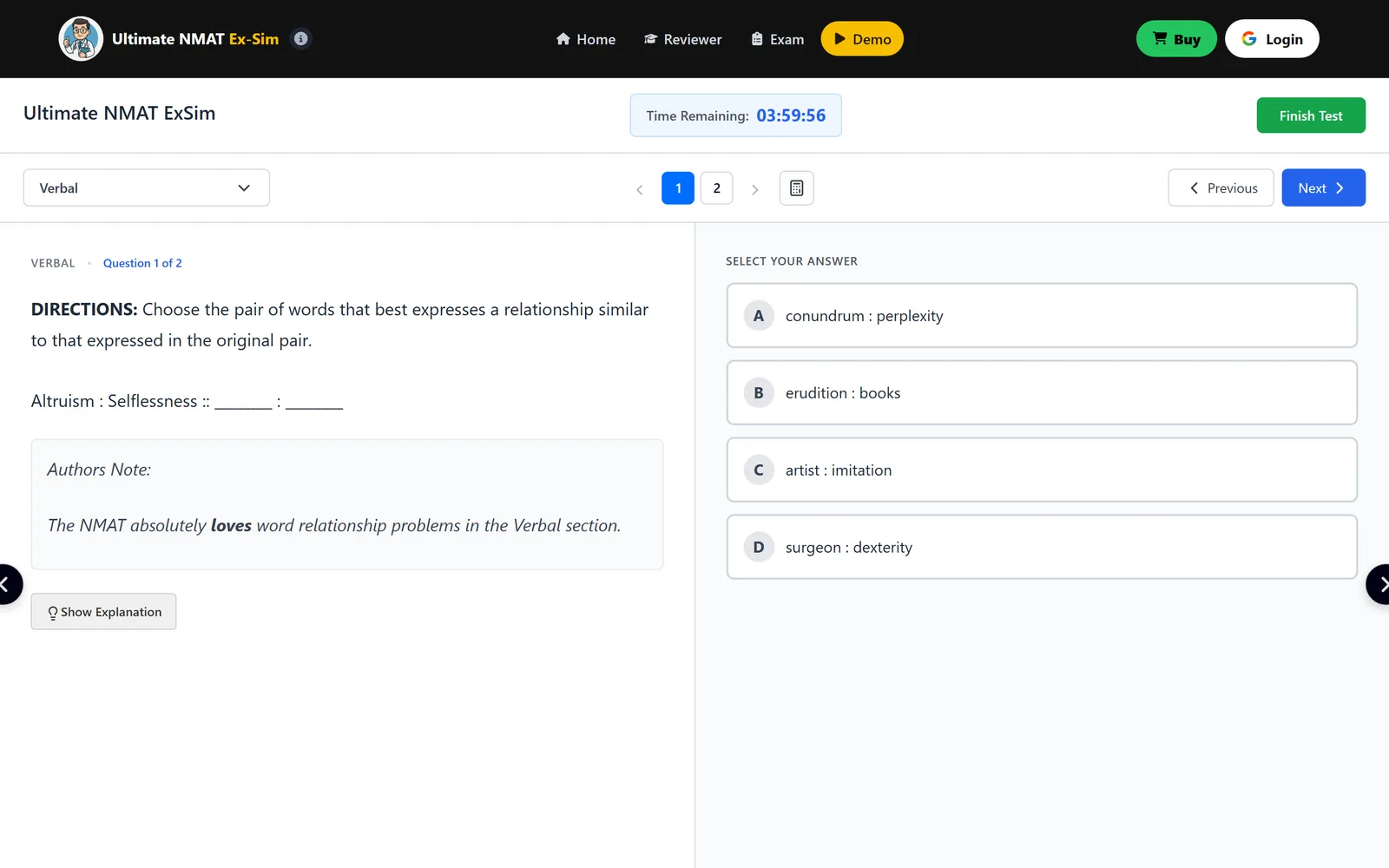
Use practice to raise your accuracy and pace. Our NMAT format post shows what you are training for, and the free demo lets you try an item in each subtest.
What are the common misreadings of an NMAT percentile?
Three misreadings account for most of the confusion we see in applicant questions. Each one is easy to correct once you hold the definition steady.
- "My percentile is my percent correct." It is not. A percentile ranks you against other examinees, while percent correct counts only your own answers.
- "There is one national cut-off for everyone." The rule CEM cites is school-or-CHED, whichever is higher, so a school can set a higher bar than the Commission's.
- "A percentile never expires." The test must be taken not more than two years before admission, so an old result can lapse.
A fourth habit is worth dropping too: comparing your number with a friend's at a different school. Their requirement may not be yours, and a figure that clears one school may not clear another. Compare your result with your own list of schools, school by school, and with nothing else.
How do you find your school's requirement?
Ask the admissions office in writing, and keep the reply. The requirement may change between application cycles, and an old forum post is not evidence of the current figure.
Ask four things: the percentile required for your intake, whether it applies to the overall result or to subtests, the latest acceptable test date, and which document the school accepts as proof. On the last point, remember that CEM's electronic copy is not valid for admission, while the official ERF is (CEM, Results release).
CEM also links a Medical Schools Directory from its NMAT page, which can help you find contact details. Treat it as a starting point and confirm the requirement with the school itself.
Frequently asked questions
What is a good NMAT percentile?
A good NMAT percentile is one that meets or exceeds your target school's requirement, which varies by school. CEM states the rule as a percentile not lower than the one prescribed by the school or CHED, whichever is higher. Ask each school's admissions office for its current figure.
Is there a CHED minimum NMAT percentile?
CHED prescribes a percentile, and the rule is that your result must be not lower than the one prescribed by the school or CHED, whichever is higher. The CEM page we rely on does not publish a number, so we do not quote one. Confirm the current figure with CEM or your school.
How long is my NMAT result valid?
The NMAT must be taken not more than two years from the time of admission to medical school. Count from your test date to the start of the term you are applying for. Check your target school's entry date so your result does not lapse first.
Is there an NMAT passing score?
No. The NMAT is an admission test that reports percentile ranks, so there is no pass or fail mark. What counts is whether your percentile meets the figure prescribed by the school or CHED, whichever is higher.
Sources
From the publisher
Meet the NMAT clock here first.
Ultimate NMAT is an NMAT simulator: full-length practice exams and subtest drills in all eight NMAT subtests, sat on a clock, with an explanation behind the items instead of a bare answer key.
- 4,670 practice items in all eight NMAT subtests
- nine full-length practice exams (A to I), 2,320 items
- eight subject drill tracks of ten sets each, 2,350 items
- An interactive reviewer and simulation lab beside the question bank
Try the free NMAT simulator demo A short sample in all eight subtests. No account needed.
About this article
Written by the Ultimate NMAT editorial team, who build the Ultimate NMAT Ex-Sim. Exam facts are checked against the Center for Educational Measurement (CEM) test pages and the CHED issuances CEM cites, and every article lists its sources. How we write and check our articles.
First published .