
The NMAT explained7-minute readFor NMAT takers
The NMAT format: two parts, the subtests, and the timing
The NMAT format in one page: 240 online items, two parts of 120, the eight subtests, the time for each part and the 10-minute break.
If you are searching for the NMAT format, here is the short version. The National Medical Admission Test is now taken online, with 240 multiple-choice items split into two parts of 120. Part 1 measures mental ability and Part 2 measures academic proficiency. Eight subtests sit across the two parts, and the clock for each part is fixed.
This post gives you the whole layout in one place: what each part contains, how much time you get, where the break falls and what kind of test the NMAT is. Every exam fact is tied to a page from the Center for Educational Measurement (CEM), listed under Sources. Our own practice material is described only where we say so.
How is the NMAT set out at a glance?
The online NMAT has 240 multiple-choice items, each with four or five options, split into two parts of 120 items (CEM, Brief Description of the Test). CEM's page counts five sections, but the content falls into eight subtests, four per part. The table below is the layout we plan around.
| Part | Items | Time | Subtests |
|---|---|---|---|
| Part 1: mental ability | 120 | 2 h 15 min | Verbal, Inductive Reasoning, Quantitative, Perceptual Acuity |
| Break | none | 10 min | none |
| Part 2: academic proficiency | 120 | 1 h 30 min | Biology, Physics, Chemistry, Social Science |
Before Part 1 starts, CEM's schedule includes 12 minutes for the important reminders and the certifying statement. After Part 2 there is a 1-minute end-test page. Those minutes are not answering time, but they belong to the sitting, so keep them in mind when you plan your day.
What is in Part 1, the mental-ability part?
Part 1 has 120 items and 2 hours 15 minutes, and it tests mental ability rather than school content. It contains four subtests, which CEM describes as follows.
- Verbal: word analogies and reading comprehension.
- Inductive Reasoning: number, letter and figural series.
- Quantitative: fundamental operations, problem solving and data interpretation.
- Perceptual Acuity: hidden figures, mirror images and identical information.
All of this is from CEM's brief description of the test. The page does not publish how the 120 items divide among the four subtests, so we do not state a split. That matters for planning: do not assume equal sizes, and train all four.
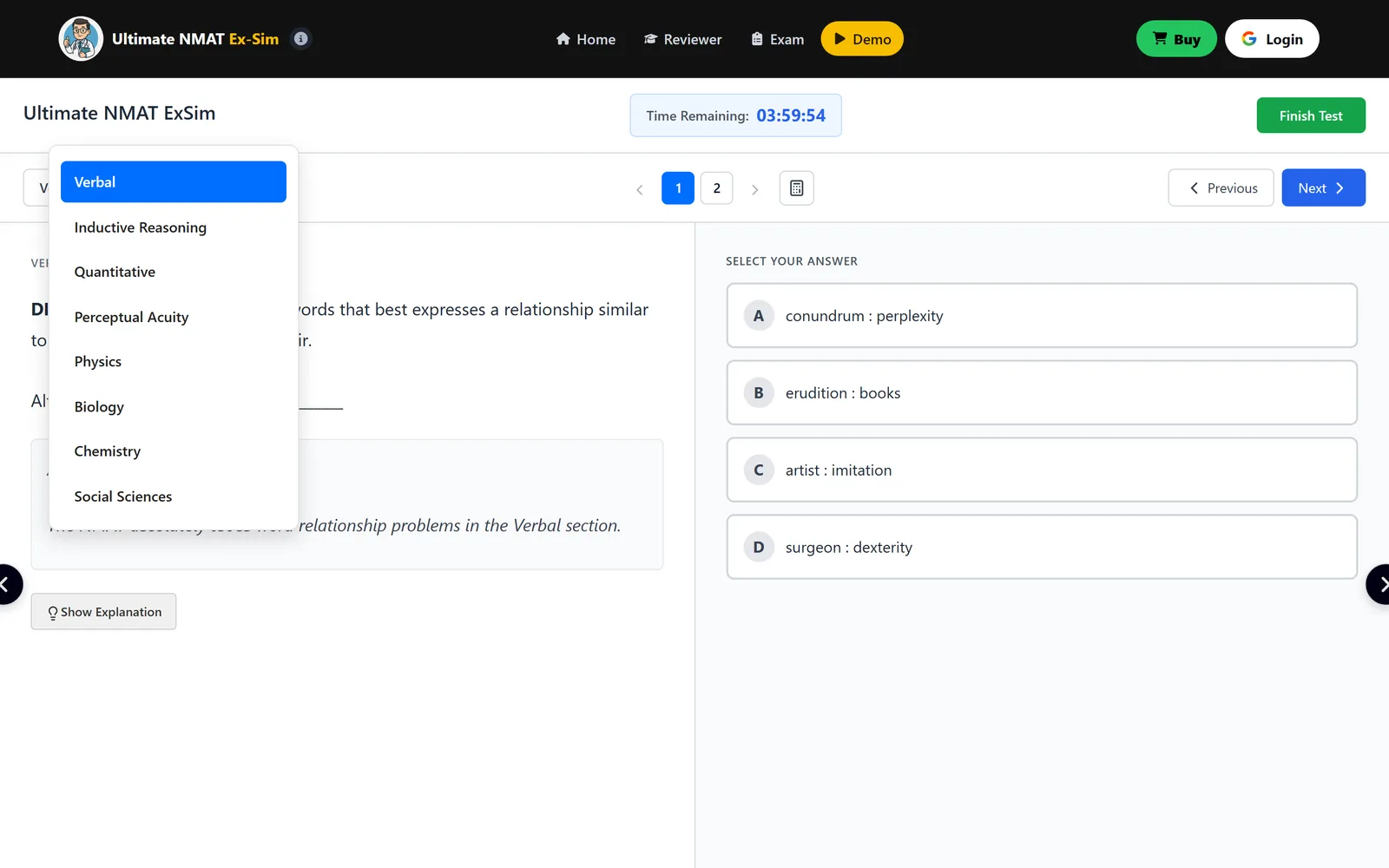
Part 1 is where speed habits show up first. The first item on the screen arrives after the reminders, and nothing in the content is something you can look up. Our free demo lets you see each of these subtests in a short sample, including a figure-series item in Inductive Reasoning, on the demo page.
What is in Part 2, the academic-proficiency part?
Part 2 has 120 items and 1 hour 30 minutes, and it tests the sciences you studied in college. CEM lists four subtests: Biology, Physics, Chemistry and Social Science, the last described as psychology, sociology and anthropology (CEM, Brief Description of the Test).
Two things stand out. First, Social Science is a full subtest, so a plan built only on the three natural sciences leaves a gap. Second, Part 2 has less time per item than Part 1, which changes how you review. Recall has to be quick, because there is little room to work an item out from scratch.
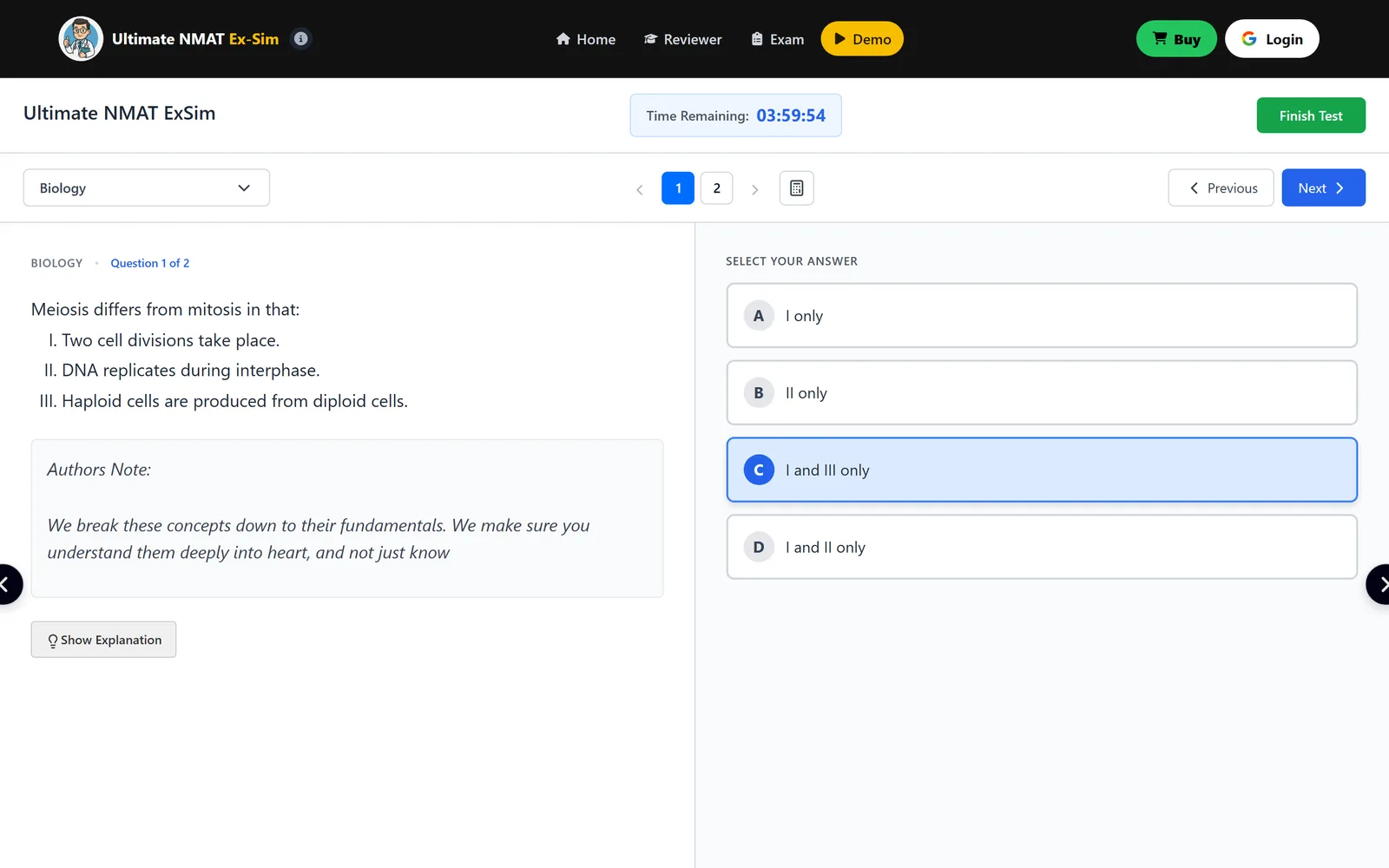
The image below shows a Biology item as it appears in our demo: a statement-style question on meiosis and mitosis, with Roman-numeral statements and four options. Items in this style reward knowing the concept cold. For subject-by-subject review ideas, see our guide to NMAT Part 2 science review.
How does the timing work, and where is the break?
You get 2 h 15 min for Part 1, a 10-minute break, then 1 h 30 min for Part 2. Both parts have 120 items, so the time per item is not the same. That is plain arithmetic on CEM's numbers.
| Part | Minutes | Items | Seconds per item |
|---|---|---|---|
| Part 1 | 135 | 120 | 67.5 |
| Part 2 | 90 | 120 | 45 |
Part 1 averages 67.5 seconds an item and Part 2 averages 45 seconds. These are averages, and individual items will take more or less. We cover how to use them in our post on NMAT time management.
The break is 10 minutes, set between the parts. Plan what you will do in it: stand up, drink water and reset. Do not plan to spend the break on your phone, which is among the items CEM prohibits during the test.
Is the NMAT a licensure exam?
No. The NMAT is an admission test. CEM states that its aim is to upgrade the selection of applicants seeking admission to Philippine medical schools, and medical school admission has required it since school year 1986-1987 (CEM, Background of the NMAT).
That has two practical consequences. The first is that nothing about the test is pass-or-fail in the board-exam sense; results are read as percentile ranks, which we explain in our post on the NMAT percentile. The second is that the test is built around mental ability and college-level science, so you are being compared with other applicants, not graded against a licensing standard.
The online NMAT format was launched in August 2020, and the test is administered by CEM. If you meet a source that describes a different NMAT, such as one run by a business-school body, it is not this test.
How long is the whole sitting?
The full sitting is about 4 hours 8 minutes from the first reminders page to the end-test page. Add CEM's published segments: 12 minutes of reminders and certifying statement, 135 minutes of Part 1, a 10-minute break, 90 minutes of Part 2 and a 1-minute end-test page. That is 248 minutes (CEM, Brief Description of the Test).
Only 225 of those minutes are answering time. The rest is administration and rest.
Plan your day around the longer figure. Eat before you start, sit down with water within reach, and tell the people around you that you will be unavailable for more than four hours. Many takers rehearse only the item-answering part and then find that four hours on camera is a different kind of tiring. A full-length rehearsal, with both parts and a real break, is the only way to find out how your concentration holds up across the whole sitting.
Has the NMAT format always looked like this?
No. CEM has administered the NMAT since its first administration in December 1985, and the online format launched in August 2020 (CEM, Background of the NMAT). We describe only the current online format, because it is the one CEM's brief description covers.
This matters when you pick study material. An older reviewer may describe a different layout, and so may a friend who sat the test years ago. Check the item count, the part times and the subtest names against CEM's page before you trust a layout.
The same caution applies to our own material. Ultimate NMAT's full exams E to I follow the current 240-item format. Exams A to D are an older 280-item format that we keep for extra practice, so use E to I when you want a faithful rehearsal of the layout described here.
How do you practise the NMAT format?
Practise in the same shape as the real thing: two blocks, with the same split of time. The format is the thing most reviewers do not rehearse, and it is the easiest to rehearse.
- Do a Part 1 block of 120 items against 135 minutes.
- Take a real 10-minute break.
- Do a Part 2 block of 120 items against 90 minutes.
Ultimate NMAT has nine full practice exams. Exams E to I follow the current 240-item format, and A to D are an older 280-item format kept for extra practice. There are also eight subject drill tracks of ten sets each. Explanations accompany most items, which helps when you review.
The demo has 19 items across all eight subtests and needs no account. Start with the free demo to see how the subtest menu and the clock behave before you commit to a full sitting.
Frequently asked questions
How many items are in the NMAT?
The online NMAT has 240 multiple-choice items. They are split into two parts of 120 items each, with four or five options per item, according to the Center for Educational Measurement (CEM). Part 1 covers mental ability and Part 2 covers academic proficiency.
How long is each part of the NMAT?
Part 1 is 2 hours 15 minutes and Part 2 is 1 hour 30 minutes, with a 10-minute break between them. CEM's schedule also includes 12 minutes for the important reminders and certifying statement before Part 1, and a 1-minute end-test page after Part 2.
Who gives the NMAT?
The Center for Educational Measurement, Inc. (CEM) administers the NMAT. It has run the test since the first administration in December 1985. The NMAT is required for admission to Philippine medical schools under CHED issuances that CEM cites.
What are the eight NMAT subtests?
Part 1 has Verbal, Inductive Reasoning, Quantitative and Perceptual Acuity. Part 2 has Biology, Physics, Chemistry and Social Science. Social Science covers psychology, sociology and anthropology, per CEM's description of the test.
Sources
From the publisher
Meet the NMAT clock here first.
Ultimate NMAT is an NMAT simulator: full-length practice exams and subtest drills in all eight NMAT subtests, sat on a clock, with an explanation behind the items instead of a bare answer key.
- 4,670 practice items in all eight NMAT subtests
- nine full-length practice exams (A to I), 2,320 items
- eight subject drill tracks of ten sets each, 2,350 items
- An interactive reviewer and simulation lab beside the question bank
Try the free NMAT simulator demo A short sample in all eight subtests. No account needed.
About this article
Written by the Ultimate NMAT editorial team, who build the Ultimate NMAT Ex-Sim. Exam facts are checked against the Center for Educational Measurement (CEM) test pages and the CHED issuances CEM cites, and every article lists its sources. How we write and check our articles.
First published .