
Your situation7-minute readFor applicants retaking the NMAT for a higher percentile
An NMAT retake plan: how to raise your percentile next time
An NMAT retake plan for a higher percentile: diagnose each subtest, change your method, pick the next window and follow a 6-week schedule.
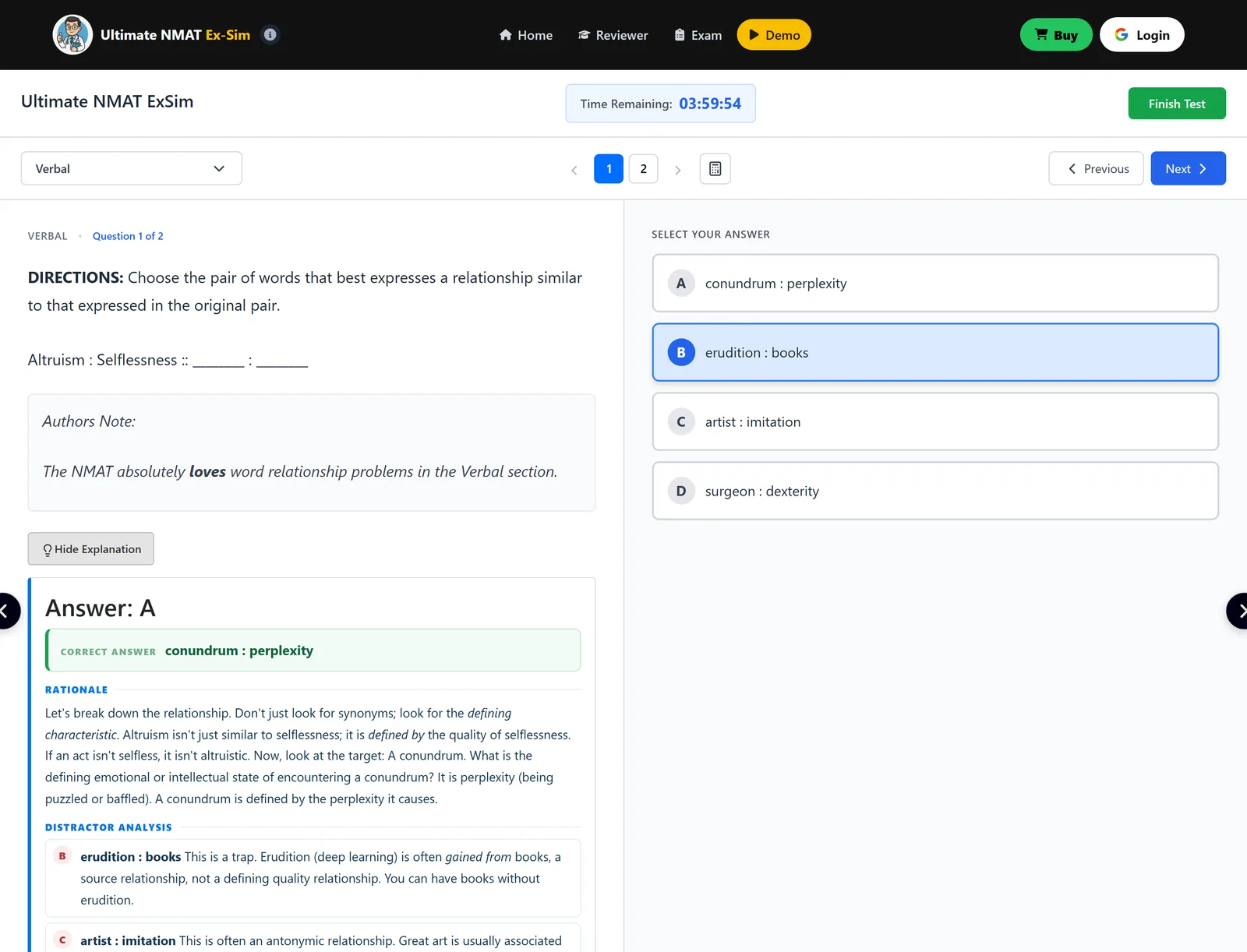
A disappointing result is not the end of the road. If you are planning an NMAT retake, the useful question is not "how many more hours?" but "what will be different this time?" This post helps you read your result, find the weak subtests, change your method and choose a window.
The NMAT is an admission test, not a licensure exam, and CEM reports results as percentile ranks. There is no pass or fail on the NMAT itself. What matters is whether your percentile meets what your target school prescribes, so we plan the retake around raising it.
What should you do first after a disappointing result?
First, wait for the valid document and read it calmly. CEM says an electronic copy is available after twenty CEM business days from the last test date, but it is not valid for admission purposes. The official ERF is mailed after six weeks (CEM results page).
Then compare your result with what your target schools prescribe. CEM's rule is that the percentile must be equivalent to or higher than that prescribed by the school or the Commission, whichever is higher (CEM eligibility page). Schools publish or tell you their own figures, so ask the admissions office directly.
Do not decide anything on the day you read the result. Give yourself two or three days, then write down what happened in the sitting: pacing, panic, topics you had never seen. That note becomes the start of your plan.
CEM lists people who failed to reach the minimum cut-off score, and people with valid eligibility who want to improve their scores, among those who may take the NMAT.
How do you diagnose which subtests held you back?
Diagnose by subtest, because a single overall number hides where the damage happened. The NMAT has two parts of 120 items. Part 1 covers Verbal, Inductive Reasoning, Quantitative and Perceptual Acuity; Part 2 covers Biology, Chemistry, Physics and Social Science (CEM test description).
Sit one fresh full-length practice exam under the real clock, then log every miss by subtest and by cause: did not know it, ran out of time, misread, or made an arithmetic slip. Our question review method explains the log in detail.
Two findings matter most. If most misses are content gaps, you need to relearn the material. If most are speed or misreads, you need timed practice, not more reading. The table maps common signs to fixes.
| Diagnosis | Sign | Fix |
|---|---|---|
| Content gap | You cannot explain the answer even with time | Relearn the topic, then drill it in short sets |
| Pace problem | You leave blanks or guess in the last minutes | Time every set; set checkpoints per part |
| Misreading | You choose an option that answers a different question | Underline the ask before looking at options |
| Arithmetic slips | The method is right but the figure is wrong | Daily mental-maths drill without a calculator |
| Panic | Strong in practice, weak under the clock | Proctor-like rehearsal, as in our test-day guide |
How do you change the method, not just the hours?
Change one concrete thing about how you practise: commit to an answer before looking at the explanation, review every miss, and drill the weakest subtest on a clock. Doing the same routine for longer rarely moves a percentile.
Many repeat takers read a lot and sit few timed exams. If that sounds like you, flip the ratio. Use the reviewer to rebuild a topic, then test it with a timed drill the same day. Ultimate NMAT has eight subject drill tracks of ten sets each, and explanations accompany most of its 4,670 items, so each miss comes with a reason.
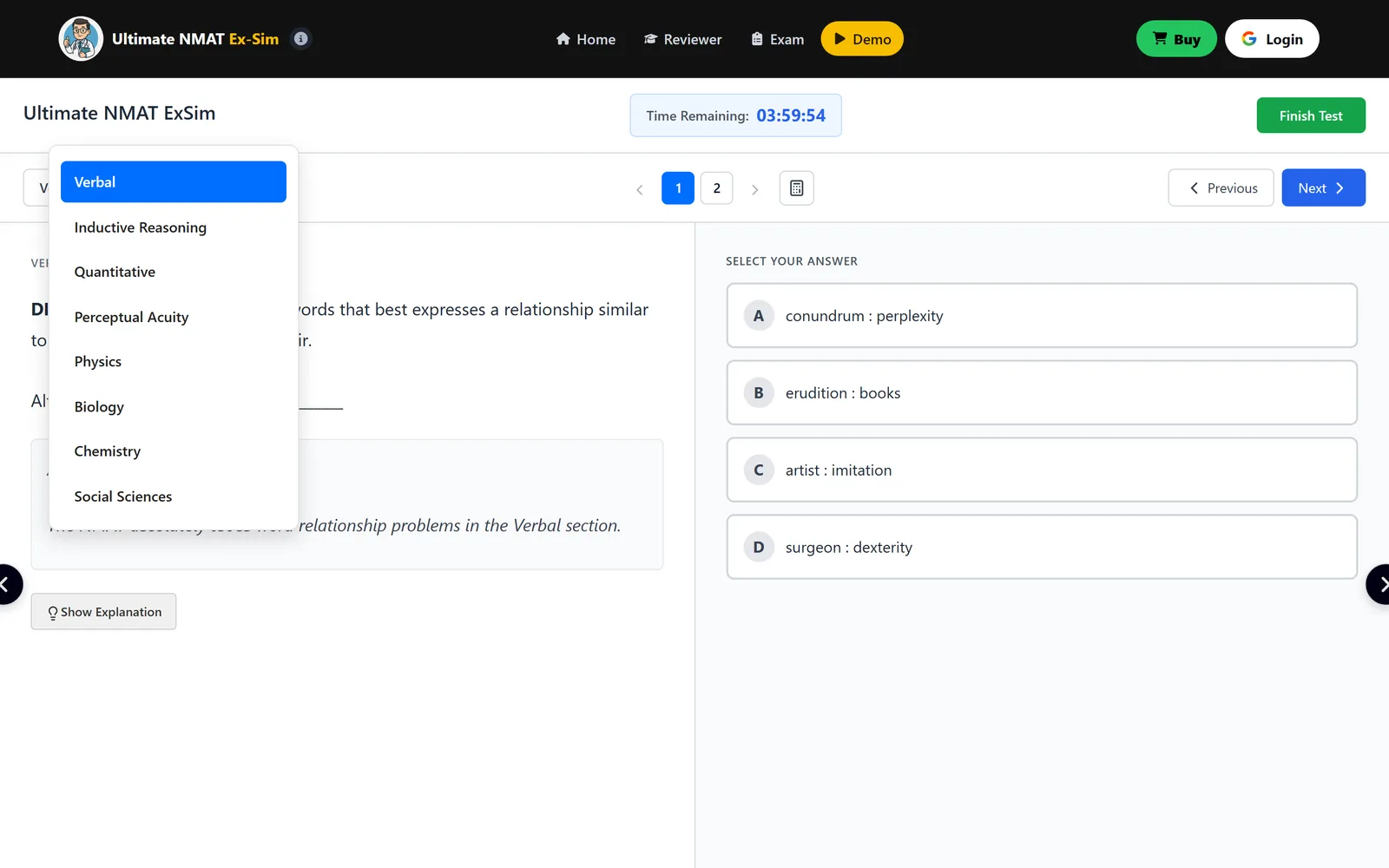
Use the subtest menu to jump straight to the weakest area.
Which subtests give the biggest gain?
The subtests with the most recoverable weakness give the largest gain, and speed-based ones usually respond to practice. Quantitative and Perceptual Acuity are skills you can speed up with daily timed work, while a science subtest improves when a specific topic gap closes.
We cannot give you a typical gain, because CEM publishes no percentile distributions and we will not invent one. Treat any promised jump with suspicion.
Rank your subtests from weakest to strongest and give your time in that order. Spend about half of your weekly hours on the bottom two, a quarter on the middle, and the rest keeping your strongest sharp. Part 1 allows about 67 seconds an item on average and Part 2 about 45 seconds, going by CEM's published timing, so a slow science recall costs more than a slow reasoning item.
Re-test the bottom two after two weeks with fresh timed sets. If a subtest has not moved, change the way you study it instead of adding hours.
How do you pick your next window for an NMAT retake?
Pick the earliest window that gives you six honest weeks of preparation and still leaves time for the ERF to reach your school. CEM says online administrations are typically scheduled October to November, January to February and April to May (CEM background page). Confirm current dates and registration on the CEM NMAT page.
Work backwards from your application deadline. The ERF is mailed after six weeks from the last test date, so a sitting in the month before the deadline is risky. Our schedule and results guide explains how to plan this.
Keep the two-year rule in view: the NMAT must be taken not more than two years from the time of admission. An earlier score may still be valid, but which score a school uses is its own policy, so ask. Do not rush into a window you are not ready for. A rushed second attempt often repeats the first.
What does a six-week retake plan look like?
A six-week retake plan alternates diagnosis, repair and rehearsal. Adapt the hours to your work or study schedule.
| Week | Focus | Target |
|---|---|---|
| 1 | One full exam under the clock, then a complete error log | A ranked list of weak subtests |
| 2 | Drills on the weakest two subtests, with explanations | Fewer content misses |
| 3 | Pace work: timed sets with checkpoints | No blanks in the last minutes |
| 4 | A second full exam, then a log comparison | Proof the method works |
| 5 | Drill the remaining gaps; daily mental maths | Fewer slips |
| 6 | One final full exam, setup check, lighter load | Calm and ready |
Our general 8-week study plan stretches the same idea if you have more time. Try the free demo to check how the exam room and the explanations feel before you start.
What does a percentile change actually mean for a retake?
A percentile rank describes where you stand relative to other examinees, so a higher figure means you outperformed more of them. It does not mean you answered a fixed share correctly. That is why a retake can raise your standing even if you feel you studied the same way, and why it can stay flat if everyone else also improved.
We cannot publish the distribution, because CEM's pages we could open give none. What you can control is accuracy and pace on each subtest. Our guide to how the NMAT percentile works explains the idea and how schools use it.
Aim your plan at the figure your target school prescribes, not at a number you saw in a forum. Ask the school what it requires, and write that down as your goal.
Frequently asked questions
How many times can I take the NMAT?
CEM's eligibility page states no maximum number of retakes, and we have not found a waiting period either. Rules can change, so confirm with CEM on the official NMAT page before you register. The page does list people who want to improve their scores among those who may sit.
Which score do schools use if I have two?
That is the school's policy, not something CEM's pages settle. Some schools may look at your latest valid result, others at your highest score. Ask the admissions office of each target school in writing, and keep the answer.
How much can I improve on a retake?
We cannot say. CEM publishes no percentile distributions, and individual gains vary with the method, the subtests and the time spent. A defined plan gives you a fair chance, but no honest source can promise a percentile.
Is an electronic copy enough to apply?
No. CEM says the electronic copy is not valid for admission purposes, and that the mailed ERF is the valid document. Plan the timing so the ERF arrives before the school's deadline.
Sources
- Results release — Center for Educational Measurement
- Eligibility and Registration Requirements — Center for Educational Measurement
- Brief Description of the Test — Center for Educational Measurement
- Background of the NMAT — Center for Educational Measurement
- NMAT home and online registration — Center for Educational Measurement
From the publisher
Meet the NMAT clock here first.
Ultimate NMAT is an NMAT simulator: full-length practice exams and subtest drills in all eight NMAT subtests, sat on a clock, with an explanation behind the items instead of a bare answer key.
- 4,670 practice items in all eight NMAT subtests
- nine full-length practice exams (A to I), 2,320 items
- eight subject drill tracks of ten sets each, 2,350 items
- An interactive reviewer and simulation lab beside the question bank
Try the free NMAT simulator demo A short sample in all eight subtests. No account needed.
About this article
Written by the Ultimate NMAT editorial team, who build the Ultimate NMAT Ex-Sim. Exam facts are checked against the Center for Educational Measurement (CEM) test pages and the CHED issuances CEM cites, and every article lists its sources. How we write and check our articles.
First published .