
Comparisons6-minute readFor pre-meds building their materials
NMAT reviewer vs simulator: which one moves your percentile
An NMAT reviewer rebuilds content; a simulator rebuilds speed and the two-part structure. See what each does best, where each stops and when to use them.
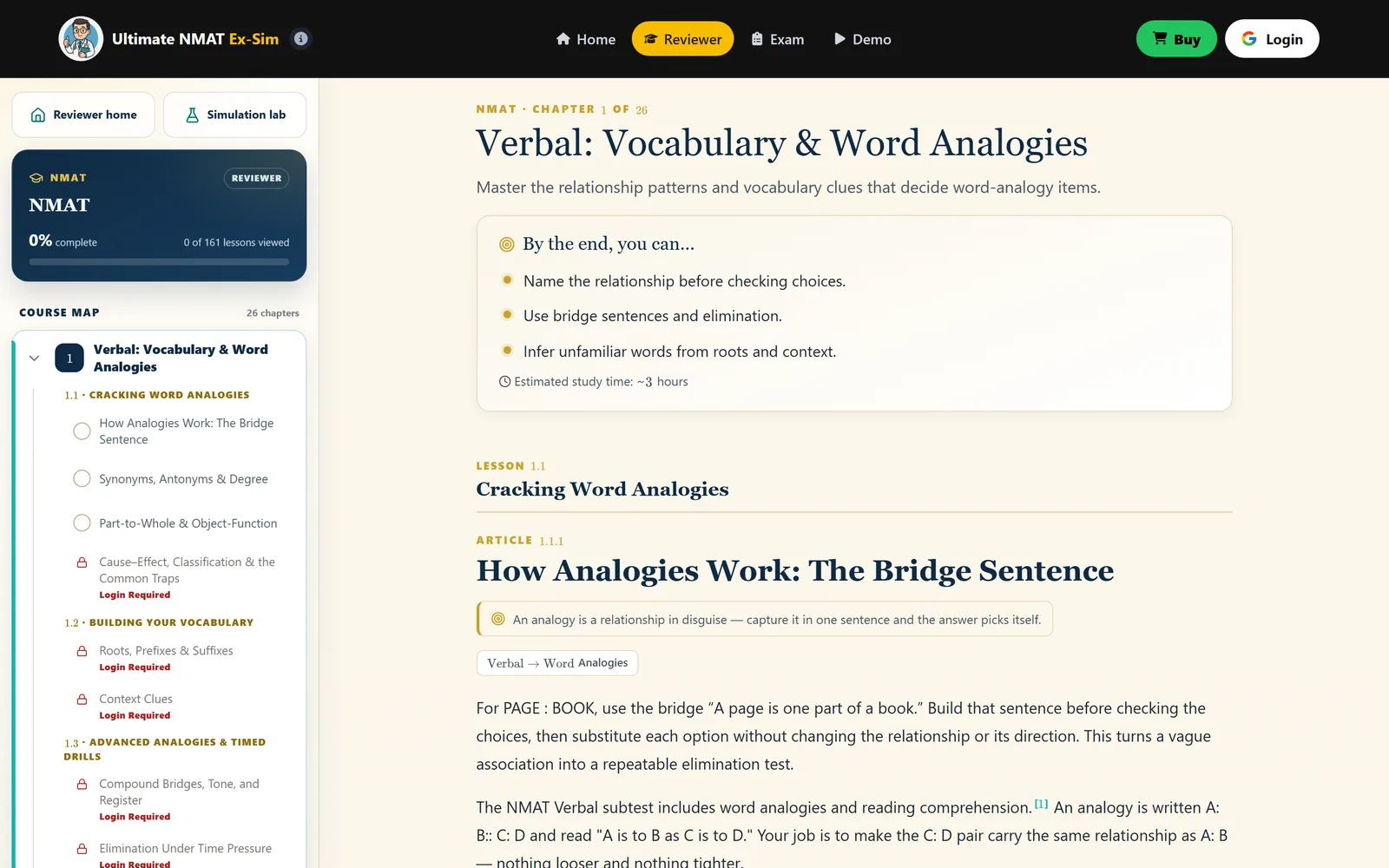
When people search for an NMAT reviewer, they usually mean a book, a PDF or a set of lessons that teaches what is on the test. That is a sensible first purchase. The trouble starts when the reviewer becomes the whole plan, because the NMAT is a timed test and a reviewer is not. This post compares the two tools fairly, so you can decide what to use and in what order.
Ultimate NMAT, which publishes this blog, makes both a simulator and an online reviewer, so we have an interest here. We try to say plainly what each category does well and where it stops, and we do not name or rank competitors.
What is the short answer?
Use a reviewer to learn, and a simulator to perform. A reviewer improves what you know, while a simulator improves what you can do in 225 minutes of testing time with a 10-minute break in the middle.
CEM describes the Online NMAT as 240 multiple-choice items in two parts of 120, with Part 1 at 2 hours 15 minutes and Part 2 at 1 hour 30 minutes. That structure creates two separate problems for a reviewee: not knowing the material, and not being able to use it fast enough. A reviewer solves the first. A simulator exposes and then trains the second.
The table below puts the two side by side on the criteria that matter for this test.
| Criterion | Reviewer (book, PDF, lessons) | Simulator |
|---|---|---|
| Rebuilds content | Strong | Limited; relies on explanations |
| Matches the 240-item, two-part format | No | Yes, if the exam is current |
| Enforces the clocks | No | Yes |
| Trains stamina | No | Yes |
| Practises figure items | Weak in text | Yes, on screen |
| Shows weak subtests with data | Only if you self-score | Yes |
| Best moment to use | Early and during repair | Baseline, then final weeks |
What does an NMAT reviewer do well?
Reviewers are good at the slow, necessary work of rebuilding content. A well-made reviewer lets you move at your own speed, return to a hard idea three times and see how topics connect. That matters most in Part 2, where CEM lists Biology, Physics, Chemistry and Social Science (psychology, sociology and anthropology), and where a gap in knowledge cannot be fixed by speed.
Print and PDF reviewers also travel well. You can read on a jeepney or in a waiting room without a connection, and you can annotate freely. For vocabulary, formulas and tables of facts, that is hard to beat.
Interactive reviewers add something extra. Ours at /learn/ has 26 chapters, 161 lessons and 28 simulations, and some lessons and the simulation pages need a login. Whatever the format, a good reviewer states objectives, teaches one idea at a time and tells you how the idea appears in an item.
Choose a reviewer first if you are returning to science after years away, or if your baseline shows content gaps rather than timing problems.
Where do reviewers stop?
Reviewers stop where the clock starts. They cannot enforce time, and they cannot reproduce the format's particular demands.
Four limits come up repeatedly:
- No pace. Nothing stops you spending four minutes on a Chemistry item. Part 2 allows 45 seconds an item.
- No structure. The NMAT is two parts with a break. A reviewer is organised by topic, so you never rehearse the sequence.
- Weak on figures. Perceptual acuity, which CEM describes as hidden figures, mirror images and identical information, depends on seeing and comparing figures quickly, and text pages cannot train that well.
- Dated formats. An older book may describe a different test layout. The online NMAT launched in August 2020, so check a reviewer's edition and what it says about the format.
None of this makes reviewers bad. It means a reviewer finishes at the edge of the exam room and cannot take you inside it.
What does a simulator add?
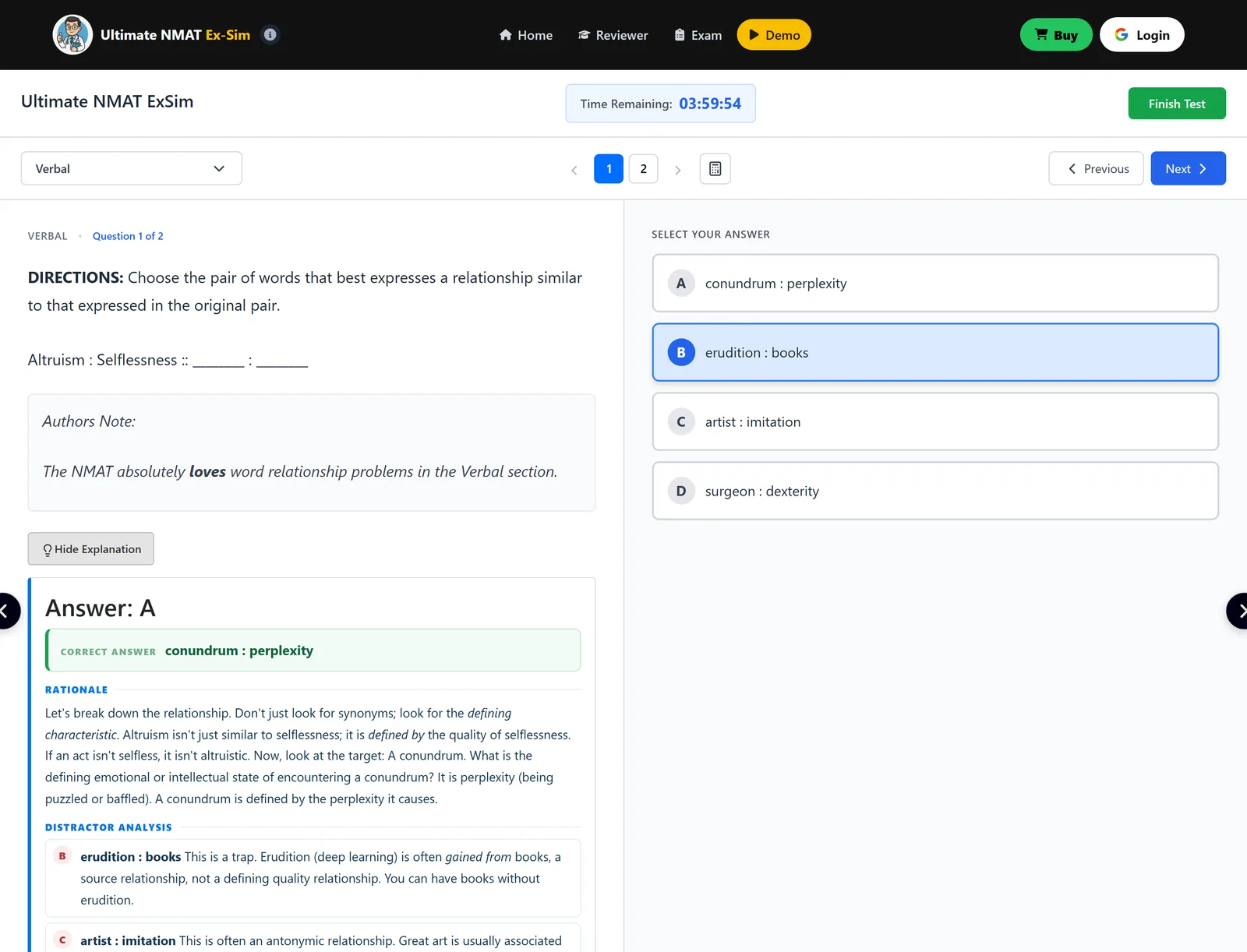
A simulator adds the clock, the structure and the data. You sit a part, it ends when time ends, and afterwards you can see which subtests cost points and which cost minutes.
The format effects are real. You learn that Verbal reading comprehension can quietly eat Part 1 time, that a Quantitative item without a physical calculator needs a shortcut (physical calculators are prohibited on test day), and that your accuracy dips in the last third of Part 2. A reviewer cannot tell you any of these things, because it has never watched you work.
Ultimate NMAT gives you nine full-length practice exams (A to I), plus eight drill tracks of ten sets each. Exams E to I follow the current 240-item format; A to D are an older 280-item format kept for extra practice. Explanations accompany most items, and that is where a simulator starts to overlap with a reviewer. See what an NMAT simulator is for the fuller picture.
A simulator is not a teacher. If a topic is missing, the explanation can point you toward it, but you need a reviewer to rebuild it.
Which should you use, and when?
Use them in a loop: baseline, repair, rehearse. The order matters more than which one you prefer.
- Baseline. Sit one timed full exam in the first week. It costs a morning and tells you where to point everything else.
- Repair with a reviewer. For every subtest where the problem is knowledge, return to the reviewer chapter and rebuild it.
- Repair with drills. For every subtest where the problem is speed or carelessness, use short timed drills.
- Rehearse. In the last weeks, sit full exams in the real order: Part 1, break, Part 2.
For a full calendar, use the 8-week study plan. If you want to see how the simulator side behaves, the free demo has 19 items across all eight subtests and needs no account.
What does a combined plan look like in practice?
A combined plan gives the reviewer the early weeks and gives the simulator a growing share of every week after that. Here is one way to split an eight-week preparation, which you can shorten or stretch.
| Weeks | Reviewer share | Simulator share | Goal |
|---|---|---|---|
| 1 | Light | One timed full exam | Find the real gaps |
| 2 to 4 | Heavy | Short subtest drills | Rebuild weak content |
| 5 to 6 | Medium | Drills plus one timed part a week | Convert knowledge into speed |
| 7 to 8 | Light | Full exams in the real order | Rehearse the whole sitting |
The ratios are a guide, not a rule. A reviewee who is strong in the sciences but slow in Part 1 might move to drills in week two. A career shifter returning after years may need the reviewer for most of the first month, and our guide for career shifters covers that case.
Whichever split you choose, end each week with a short review of what the simulator showed. The data from timed sittings is only useful if it changes what you read next. If a Part 2 sitting shows Physics items taking twice the target time, the next reviewer session is Physics, not a chapter you already enjoy.
Frequently asked questions
Are older NMAT reviewers still useful?
Often yes for content, less so for format. Biology, Chemistry, Physics and Social Science change slowly, so a good older reviewer can still teach them. But the test is now online with 240 items in two timed parts, so do not rely on an older book for pacing or layout.
Should I study content or take practice tests first?
Take one timed practice exam first, then study content. The baseline shows whether your problem is knowledge or speed, so your reviewer time goes where it is needed. Going the other way means you may spend weeks on subjects that were already fine.
How many full exams should I take?
There is no official number, so plan by purpose. One as a baseline, then two or three in the final weeks as rehearsals, with review of each between sittings. More only helps if you analyse every sitting; sitting many without reviewing teaches little.
Sources
From the publisher
Meet the NMAT clock here first.
Ultimate NMAT is an NMAT simulator: full-length practice exams and subtest drills in all eight NMAT subtests, sat on a clock, with an explanation behind the items instead of a bare answer key.
- 4,670 practice items in all eight NMAT subtests
- nine full-length practice exams (A to I), 2,320 items
- eight subject drill tracks of ten sets each, 2,350 items
- An interactive reviewer and simulation lab beside the question bank
Try the free NMAT simulator demo A short sample in all eight subtests. No account needed.
About this article
Written by the Ultimate NMAT editorial team, who build the Ultimate NMAT Ex-Sim. Exam facts are checked against the Center for Educational Measurement (CEM) test pages and the CHED issuances CEM cites, and every article lists its sources. How we write and check our articles.
First published .