
Your situation7-minute readFor pre-med students in their final year
The NMAT for college students: when to sit and how to prepare
NMAT for college students: when to sit, how the two-year validity helps, and a term-time prep plan that protects your thesis and your grades.

You are in your last year of college, the thesis is due, and the NMAT is somewhere on the calendar. The question is not only how to study, but when to sit. This post settles the timing for NMAT for college students and gives you a term-time plan that leaves room for your grades.
We keep to what the Center for Educational Measurement (CEM) publishes. Schools set their own percentile requirements, so the aim here is to help you choose a window and a routine, not to promise a number.
Why does timing matter so much for college students?
Timing matters because the NMAT competes with your thesis, laboratory requirements and finals for the same hours. The test itself is long. CEM describes the online NMAT as 240 multiple-choice items in two parts of 120, with Part 1 at 2 hours 15 minutes, a 10-minute break and Part 2 at 1 hour 30 minutes (CEM test description).
That is close to four hours of sustained focus, plus the reminders and the end page. Sitting it in the same week as a major paper means you rehearse badly and perform worse. A sitting you plan around your calendar costs you nothing extra. A sitting you squeeze in costs you hours you did not have.
Treat the NMAT like a course with a fixed date. Count backwards from the window you want, subtract your commitments, and see how many weeks of real study remain. If the answer is under six, move to the next window.
Does the two-year validity let you take the NMAT early?
Yes. CEM states that the NMAT must be taken not more than two years from the time of admission to medical school, with a percentile score equivalent to or higher than that prescribed by the school or the Commission, whichever is higher (CEM eligibility page).
For a final-year student, that means a score you earn this school year can still count for an intake within the two-year limit. You do not need to rush into the earliest window out of fear of an expired score.
The same page lists who may take the test: college graduates, students graduating at the end of the current school year, and some second-year students of specified accelerated medicine programs. A student who is not yet in a graduating year should confirm eligibility with CEM before planning anything.
Which window should you pick?
Pick the window that sits furthest from your heaviest academic weeks, and keep a second window free as a buffer. CEM notes that online administrations are typically scheduled October to November, January to February, and April to May (CEM background page). Exact dates change, so confirm them on the CEM NMAT page before you commit.
School calendars differ, so the table below is general. Fill in your own thesis and exam dates beside each row.
| Window | Possible advantage | Possible drawback |
|---|---|---|
| October to November | Early in the school year; leaves two later windows as backup | You may have only a short summer or term break to prepare |
| January to February | Can follow a semester break for a long study block | May collide with midyear thesis deadlines |
| April to May | Close to graduation; the scores arrive before most application cycles | Overlaps with finals and graduation requirements at many schools |
Whichever you choose, plan for the second window as insurance. Our schedule and results guide explains how to plan back from school deadlines.
How should NMAT for college students fit around a term?
A term-time plan uses short daily blocks and one longer timed session every second week. Eight weeks is a sensible length, and our 8-week study plan lays out the full structure. Here is how to fit it around classes.
Weekdays get 45 to 60 minutes: one subtest drill, then a review of every miss. Saturdays get a longer block for either a drill set or a half-length timed session. Every second Sunday, sit one full exam under the real clock, in one go, with a 10-minute break between parts.
Ultimate NMAT has nine full practice exams and eight subject drill tracks, so you can match the work to the week. Explanations accompany most of the 4,670 items, which is what turns a missed question into a lesson instead of a score.
How do you protect your grades while preparing?
Protect your grades by capping NMAT study hours during exam weeks and by borrowing time from low-value habits, not from sleep. A drop in your general weighted average can cost you more at admission than a few percentile points.
Set two rules. First, in a week with a major deadline, drop to the minimum: one 30-minute drill a day and no full exam. Second, never trade a night's sleep for a practice set, because a tired mind reads analogies and number series badly.
Use your phone well. The demo and the drills load in a browser, so a ten-minute set fits on a commute. The screenshot below shows the Verbal subtest on a phone with the timer, the subtest menu and the explanation button in view.
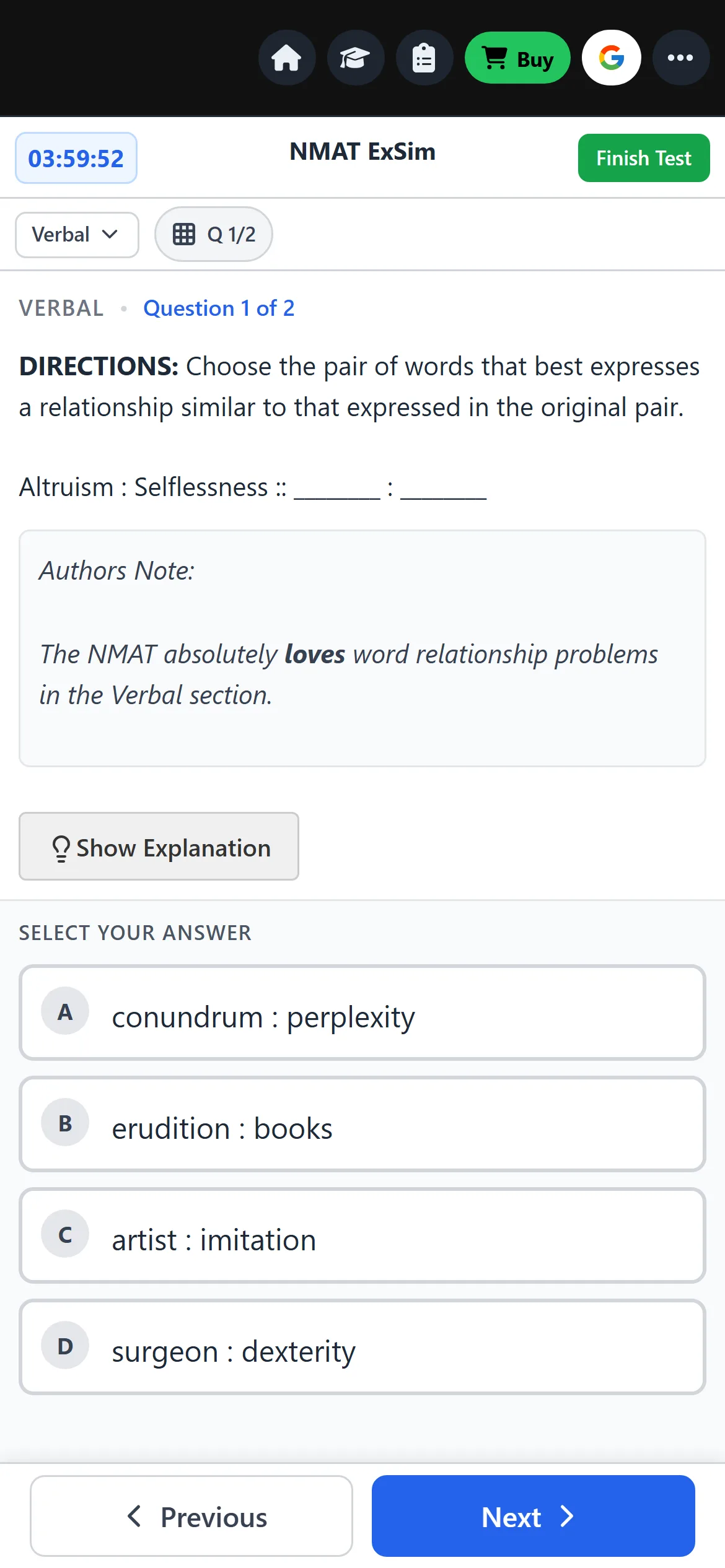
Remember that the real test is taken on a proctored online system, so do your full exams at a desk, not on a bus.
What should you do in the final two weeks?
In the last two weeks, run two full exams, repair your weakest subtest and rehearse the test-day setup. Do not start new topics. The online test is live-proctored, and CEM requires the webcam and microphone to stay on throughout; phones, watches, notes and physical calculators are not allowed (CEM test-day instructions).
Practice Quantitative without a calculator from the start, because a physical calculator is not permitted at the real test. Our guide to the online rules and setup has a full checklist.
Then wait. CEM says the electronic result is available after twenty CEM business days but is not valid for admission, and the official ERF is mailed after six weeks (CEM results page). If an application deadline is close, count those weeks before you choose a window. You can try the free demo in any subtest to test your device first.
Should you join a review class or study on your own?
Either can work, and the deciding factor is your schedule. A review class gives structure and a cohort, which helps if you drift without deadlines. Self review gives flexibility, which helps if your laboratory hours change every week.
Ask three questions. Can you attend fixed sessions during your heaviest term? Do you keep to a plan when nobody checks? Do you already know which subtest is your weakest? A student with a rigid timetable and a habit of self-study can do well alone. A student who needs accountability may prefer a class. Our comparison of review classes and self review sets out both honestly, and we publish this blog, so weigh our view accordingly.
Whichever you choose, add timed full-length practice. Reading chapters rebuilds content, but only a clock rebuilds pace.
Frequently asked questions
Can I take the NMAT in third year?
It depends on eligibility. CEM lists college graduates, students graduating at the end of the current school year, and some second-year students of specified accelerated medicine programs. A regular third-year student should confirm with CEM before registering, because the eligibility page does not list that group.
Which NMAT window is best for a final-year student?
There is no single best window. Choose the one furthest from your thesis defence and finals, and keep the next window free as a backup. CEM says online administrations typically run October to November, January to February and April to May, so check the current dates.
Should I review for the NMAT during the semester?
Yes, in small steps. Short daily drills and a timed full exam every second week fit around classes, and they build the pacing the real test needs. Reduce the load in exam weeks instead of stopping, so that the habit survives the semester.
Does an early score expire?
CEM says the NMAT must be taken not more than two years from admission to medical school. A score you earn in your final year can still count for an intake within that limit, but confirm the rule with your target school.
Sources
- Eligibility and Registration Requirements — Center for Educational Measurement
- Background of the NMAT — Center for Educational Measurement
- Brief Description of the Test — Center for Educational Measurement
- Test Day Instructions — Center for Educational Measurement
- Results release — Center for Educational Measurement
- NMAT home and online registration — Center for Educational Measurement
From the publisher
Meet the NMAT clock here first.
Ultimate NMAT is an NMAT simulator: full-length practice exams and subtest drills in all eight NMAT subtests, sat on a clock, with an explanation behind the items instead of a bare answer key.
- 4,670 practice items in all eight NMAT subtests
- nine full-length practice exams (A to I), 2,320 items
- eight subject drill tracks of ten sets each, 2,350 items
- An interactive reviewer and simulation lab beside the question bank
Try the free NMAT simulator demo A short sample in all eight subtests. No account needed.
About this article
Written by the Ultimate NMAT editorial team, who build the Ultimate NMAT Ex-Sim. Exam facts are checked against the Center for Educational Measurement (CEM) test pages and the CHED issuances CEM cites, and every article lists its sources. How we write and check our articles.
First published .