
Comparisons7-minute readFor pre-meds choosing how to prepare
NMAT review center or self review? An honest comparison
An NMAT review center gives structure and a cohort; self review gives flexibility. Compare both fairly, see who fits which, and close the gap they share.
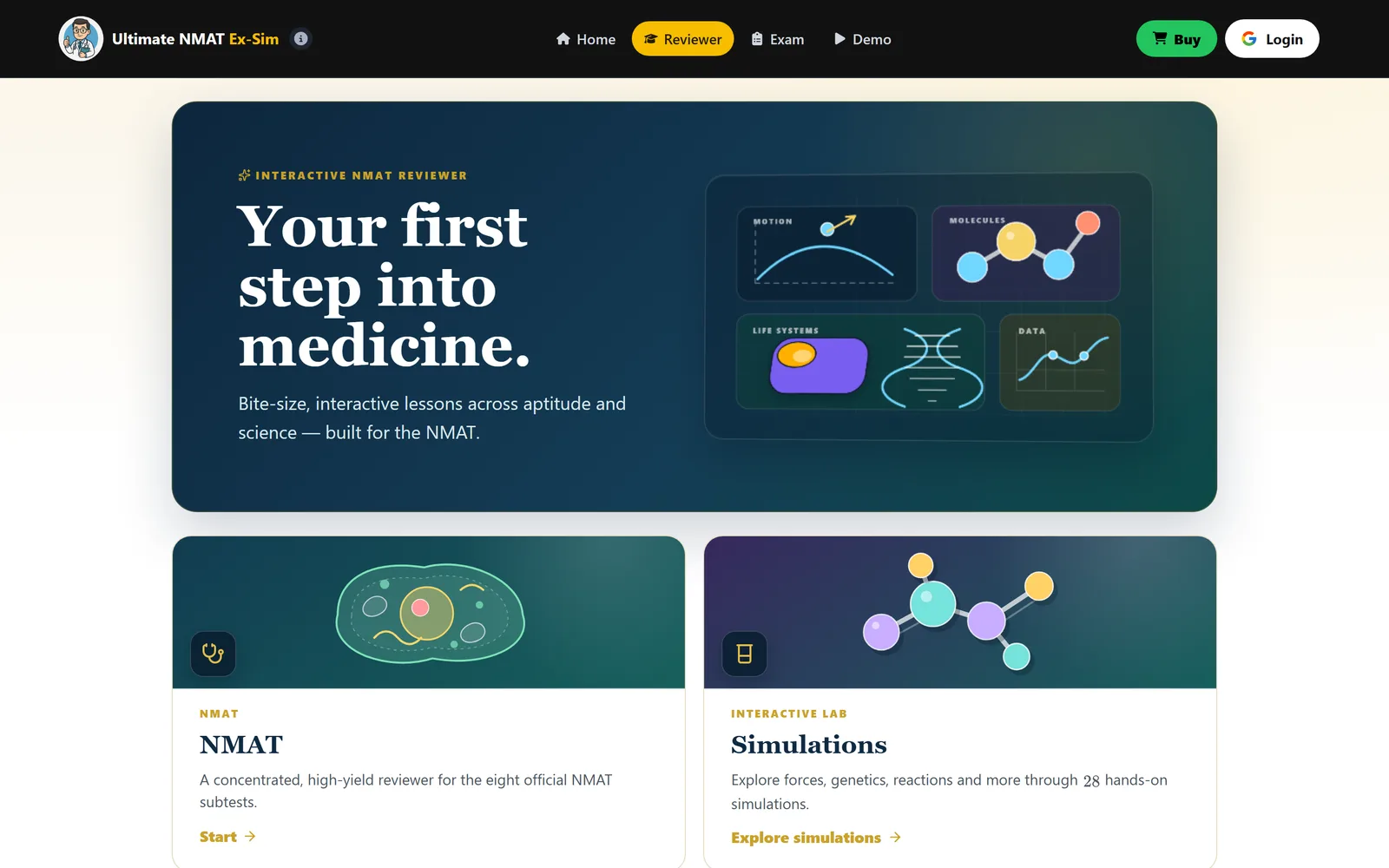
Choosing between an NMAT review center and self review is one of the first decisions a pre-med makes, and it is usually made on hearsay. Friends who joined a class say you need one; friends who studied alone say you do not. Both can be right for different people. This post lays out what each route gives, who tends to do better on which, and the one gap they share.
A disclosure: Ultimate NMAT, which publishes this blog, makes a simulator that sits on the self-review side of this comparison, so weigh our view with that in mind. We name no review centers and quote no prices, because both change and neither decides the question.
In brief: which should you choose?
Choose a review center if you need outside structure, and self review if you need control over your time. That single sentence settles most cases. The rest of this post tests it.
A review center is any organised class, whether in person or online, that teaches the NMAT content on a fixed schedule with an instructor and a group. Self review means you assemble your own materials, such as notes, a reviewer, practice questions and a simulator, and set your own calendar.
Neither route changes the test. The Center for Educational Measurement (CEM) describes the Online NMAT as 240 multiple-choice items in two parts of 120, and the clock is the same for everyone. What differs is how you reach test day: with someone steering your weeks, or steering them yourself.
| Review center | Self review | |
|---|---|---|
| Schedule | Set by the center | Set by you |
| Teaching | Live instructor | Books, lessons, videos, notes |
| Accountability | Cohort and attendance | Your own discipline |
| Fit with a busy term | Fixed hours can clash | Study in gaps |
| Full-length timed practice | Depends on the program | Depends on what you add |
| Cost of attention | High: you travel or log in on time | Lower, but you plan everything |
What does an NMAT review center give you?
A review class gives you a calendar you did not have to build, a person who can answer "why" in the moment, and classmates who notice when you disappear. For many reviewees the calendar alone is the product. Eight sessions on the schedule is eight sessions done, whether or not motivation showed up.
Live teaching also helps when you meet a topic you never learned properly. Some Part 2 content, such as sociology or anthropology inside Social Science, may not have been in your degree, and hearing it explained by a person can be faster than decoding a PDF.
Cohorts help in a quieter way. Studying alongside others tells you roughly where you stand, which is hard to judge alone. Be careful with that comfort, though: a class average is not your percentile.
A class cannot sit the test for you. Ask any program how many times you will complete a full 240-item sitting under the real clock, and whether that happens in class or at home. The answer tells you whether the class covers the rehearsal gap.
What does self review give you?
Self review gives you control of when, where and how fast you study, and that control is worth a lot to a final-year student. Thesis deadlines and duty rotations do not move for review sessions. If you can study twenty minutes between classes and two hours on Sunday, a flexible plan fits that life better than a fixed timetable.
It also lets you spend time where you are weak. If your Verbal is fine and your Physics is shaky, you can spend three weeks on Physics without waiting for a syllabus to reach it. Our 8-week plan is built this way, starting from a baseline and drilling by weakness.
The cost is that nobody checks. Self review fails quietly: you reread notes, feel productive, and discover on test day that you never practised at pace. It works best for people who have finished long projects on their own before, and who will honestly track what they did each week.
Who should choose which?
Choose a review center if you have been away from science for years, if you have repeatedly failed to finish self-set plans, or if you learn best by asking questions out loud. Choose self review if your schedule is unpredictable, if you are comfortable learning from text, or if your weak areas are narrow.
A few signals are worth checking honestly:
- You started a study plan before and dropped it within two weeks. A cohort will help.
- You learn quickly from reading. Self review will not slow you down.
- Your term timetable changes every week. A fixed class will be hard to attend.
- You are a career shifter returning after years. Structure plus a science refresher is often worth it; see our guide for career shifters.
- You are taking the NMAT mid-semester. Flexibility usually wins; see taking the NMAT while in college.
These are tendencies, not rules. Plenty of people succeed on either route and plenty struggle on both.
Can you combine a class with self review?
Yes, and it is the most common arrangement. Take a class, or an online course, for content and accountability, then add your own practice for pace. In this hybrid, the class owns "what the NMAT covers" and you own "how fast I can do it".
A workable split looks like this. The class handles Part 2 content: Biology, Chemistry, Physics and Social Science. Your own time handles the Part 1 skills, which are Verbal, Inductive Reasoning, Quantitative and Perceptual Acuity, because those improve mainly through repeated timed practice. CEM lists these subtests, including hidden figures, mirror images and numerical, letter and figural series, and they reward repetition more than lectures.
The hybrid also protects you against a weak class. If the sessions turn out slow, your independent practice still moves you forward.
What gap do both routes leave?
Both routes leave a gap in full-length timed practice unless you deliberately fill it. This is the part reviewees most often skip, because it is tiring and the results can be discouraging.
The arithmetic explains why it matters. Part 1 gives 2 hours 15 minutes for 120 items, and Part 2 gives 1 hour 30 minutes for 120, about 67.5 and 45 seconds per item. You cannot learn that pace from lectures or from reading. You learn it by sitting parts on a clock, then examining where the seconds went.
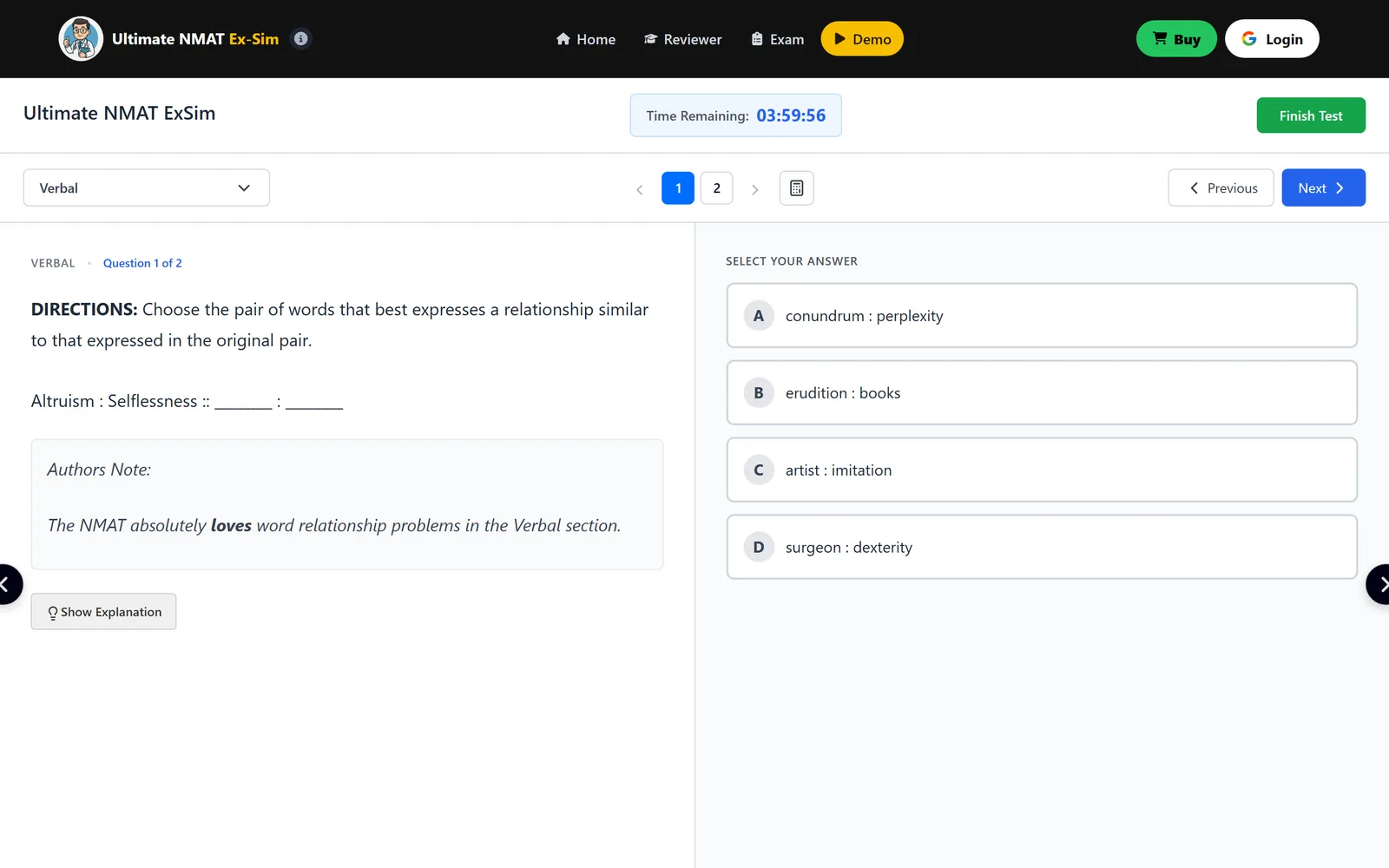
A simulator is the usual tool for this. Ultimate NMAT offers nine full-length practice exams (A to I), and exams E to I follow the current 240-item format. See what an NMAT simulator is for what to look for, and try the free demo to see the clock and explanations yourself.
Two or three full sittings, spaced across your preparation, is a reasonable minimum whatever route you choose.
When should you start, whichever route you take?
Start about eight weeks before your sitting if you are working alone, and a little earlier if a class begins on a fixed date. CEM's online administrations are typically scheduled in October to November, January to February and April to May, so choose a window first and count backwards. Confirm actual dates with CEM, which also announces registration extensions.
Remember the validity rule. The NMAT must be taken not more than two years from the time of admission to medical school, so there is no benefit in sitting far too early, and there is room to sit once you are ready.
Frequently asked questions
Can I do well on the NMAT with self review alone?
Yes, many people do. Self review works when you build a calendar, cover every subtest and practise on a clock. Its usual failure is untimed rereading. The test only rewards what you can do at pace, so make sure you sit full parts under real timing.
Do I need an NMAT review center?
No. CEM's eligibility requirements do not list a review class as a condition for taking the test. A review center helps people who need schedule, accountability or live teaching. If you already study consistently on your own, you may not need one.
When should I start preparing?
Eight weeks is a sensible planning window for a first attempt, longer if you have been away from the sciences. Work backwards from the CEM window you target, take a full exam in week one as a baseline, and keep full-length rehearsals for the final weeks.
Sources
From the publisher
Meet the NMAT clock here first.
Ultimate NMAT is an NMAT simulator: full-length practice exams and subtest drills in all eight NMAT subtests, sat on a clock, with an explanation behind the items instead of a bare answer key.
- 4,670 practice items in all eight NMAT subtests
- nine full-length practice exams (A to I), 2,320 items
- eight subject drill tracks of ten sets each, 2,350 items
- An interactive reviewer and simulation lab beside the question bank
Try the free NMAT simulator demo A short sample in all eight subtests. No account needed.
About this article
Written by the Ultimate NMAT editorial team, who build the Ultimate NMAT Ex-Sim. Exam facts are checked against the Center for Educational Measurement (CEM) test pages and the CHED issuances CEM cites, and every article lists its sources. How we write and check our articles.
First published .