
Comparisons7-minute readFor pre-meds comparing NMAT apps
How to choose an NMAT reviewer app: nine criteria that matter
Choose an NMAT reviewer app with nine checkable criteria, from the 240-item two-part format to explanations, plus a 10-minute demo test and red flags.
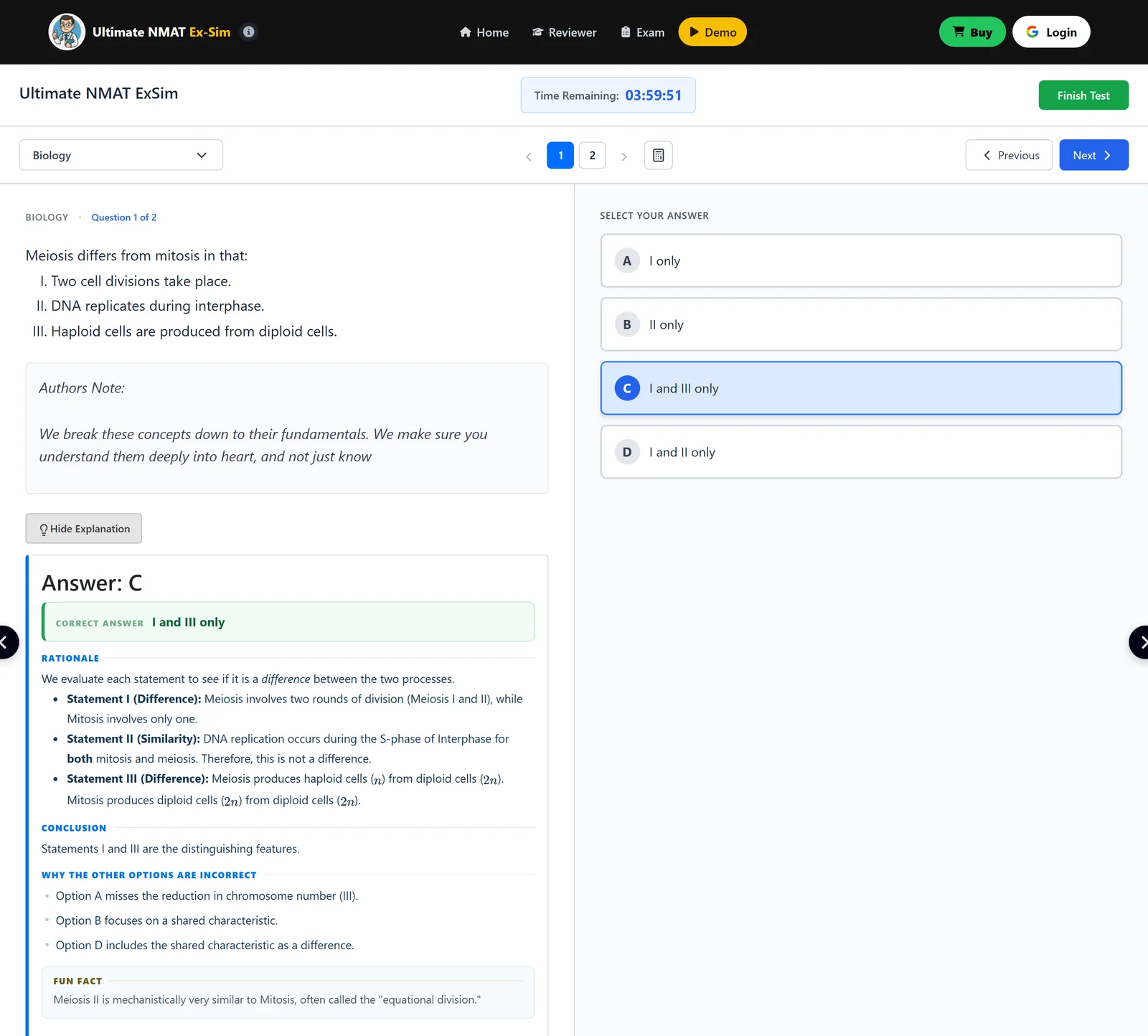
Searching for an NMAT app turns up a confusing mix: generic aptitude trainers, apps for entirely different tests, PDF viewers dressed as apps, and a few built around the real NMAT. This guide does not rank them. It gives you nine criteria for judging any NMAT reviewer app, a ten-minute way to check them, and the red flags that should make you walk away.
Ultimate NMAT, which publishes this blog, makes an app of this kind, so treat our view as that of an interested party. We name no competitors; at the end we apply the same nine criteria to ourselves and mark what you should verify rather than trust.
Why do so many NMAT reviewer app options miss the NMAT?
Many apps miss the NMAT because they were built for a different test or for a generic idea of "aptitude". The Philippine National Medical Admission Test has a specific design, and an app has to match it to be useful.
Start with the facts. The Center for Educational Measurement (CEM) states that the Online NMAT has 240 multiple-choice items, with four or five options each, in five sections, divided into Part 1 (mental ability) and Part 2 (academic proficiency) of 120 items each. A generic reasoning app has no Social Science, no hidden-figure items and no two-part clock.
Search results add to the confusion. An unrelated test with a similar acronym is used for business-school admission in India, and apps built for it share nothing with ours except three letters. If an app's screenshots talk about management or business, it is not for you.
The nine criteria below start from the real test, so each one is something you can verify.
What are the nine criteria?
Here is the checklist. Each row says what to look for and how to check it, in the app or its free demo.
| # | Criterion | Why it matters | How to check |
|---|---|---|---|
| 1 | Current format: 240 items, two parts of 120 | The structure shapes pacing | Find a full exam and count its items |
| 2 | Timing that matches each part | Part 1 is 2 h 15 min; Part 2 is 1 h 30 min | Start a full exam and read the clock |
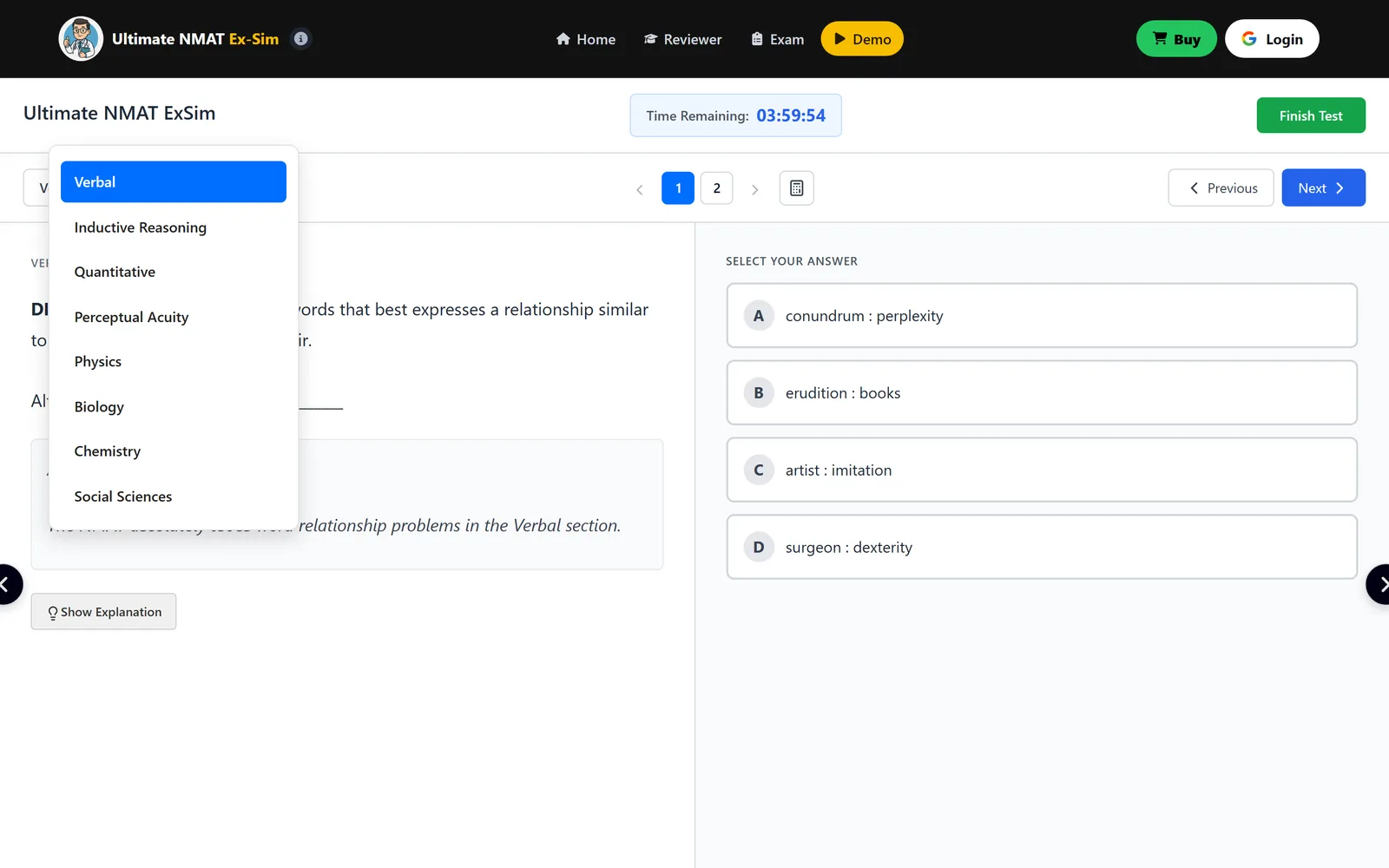
| 3 | All eight subtests | Every subtest is scored | Open the subtest menu |
| 4 | Explanations | Errors only teach if you see the reasoning | Answer an item and open the explanation |
| 5 | No-calculator maths | Physical calculators are prohibited | Do Quantitative items by hand |
| 6 | Perceptual acuity practice | Hidden figures and mirror images need visuals | Look for figure-based items |
| 7 | Progress by subtest | You need to know where time is lost | Look for per-subtest results |
| 8 | Practical online use | You will practise in gaps | Open it on your phone |
| 9 | No percentile prediction | Only CEM computes a percentile | Read the marketing claims |
How do criteria 1 to 3 work: format, timing and subtests?
Check the format, timing and subtests first, because an app that fails them cannot rehearse the test at all. Format means 240 items in two parts of 120. Timing means the clocks follow CEM: 2 hours 15 minutes for Part 1, a 10-minute break, and 1 hour 30 minutes for Part 2.
Subtests mean all eight. Part 1 has Verbal, Inductive Reasoning, Quantitative and Perceptual Acuity. Part 2 has Biology, Chemistry, Physics and Social Science. An app with only Biology and Chemistry is a Part 2 helper, which may still be useful, but it should say so.
One caution about older formats. Some practice material follows a longer, older layout. That is fine as extra practice, but your timed rehearsals should follow the current structure. Ultimate NMAT labels this plainly: full exams E to I follow the current 240-item format, while A to D are an older 280-item format kept for extra practice.
How do criteria 4 to 6 work: explanations, calculators and figures?
Explanations, no-calculator practice and figure items separate a real NMAT trainer from a generic quiz. Each is quick to test.
Explanations. A bare answer key tells you that you were wrong, not why. Look for a rationale and a note on why the other options fail. Be sceptical of any app claiming an explanation for everything; check a few items yourself, including awkward figure items.
No-calculator maths. CEM's test-day rules list physical calculators among prohibited items. Quantitative practice should therefore be solvable by hand, with numbers that suit mental arithmetic and estimation.
Perceptual acuity. CEM describes hidden figures, mirror images and identical information. These need visual items on a screen. If an app's only perceptual items are text descriptions, they are not training the real skill.
How do criteria 7 to 9 work: progress, practicality and honesty?
Progress data, practical access and honest claims decide whether you keep using an app. Progress by subtest means results broken down by Verbal, Quantitative, Biology and so on, not a single score. Without that, you cannot tell whether to spend Saturday on Physics or on pacing.
Practicality means it works where you study. Many reviewees practise in short gaps between classes or duty, so test the app on your phone and on a weak connection. Our demo has a phone layout, but check any app with your own device.
Honesty is the ninth criterion. A percentile is a ranking against other examinees, and CEM reports results that way. An app can show your accuracy and your pace, but it cannot honestly state "you will score in the Xth percentile". Treat any such promise as a red flag, and see our percentile guide for what a rank means.
How do you test an app in ten minutes?
Run this routine on any app's demo or free sample, and note a yes or no for each criterion before you pay or commit.
- Minute 1. Open the subtest menu and count the subtests.
- Minute 2. Find a full exam or a part, and check its item count and its clock.
- Minutes 3 to 5. Try one Quantitative item without a calculator.
- Minutes 5 to 7. Answer one item wrongly on purpose and open the explanation.
- Minute 8. Find a figure-based item in Inductive Reasoning or Perceptual Acuity.
- Minute 9. Look for a results page broken down by subtest.
- Minute 10. Open it on your phone.
Our free demo has 19 items across all eight subtests and needs no account, so you can run the routine on us as well. For the bigger question of tools, see NMAT reviewer vs simulator.
What are the red flags?
Walk away or check twice when you see any of these:
- Promises of a specific percentile, or "guaranteed" results.
- No mention of Part 1 and Part 2, or no eight-subtest list.
- Screenshots referring to business school or management, which points to the wrong test.
- Vague boasts of freshness or popularity with no evidence behind them.
- Explanations only for a few items, but marketing that implies all.
- No way to see a sample before committing.
- A claim to know "the cutoff". Schools set their own required percentile, as CEM's eligibility page explains: not lower than the one prescribed by the school or CHED, whichever is higher.
A chatbot can fall into some of these traps too; our post on ChatGPT for NMAT review covers it.
How does Ultimate NMAT measure up?
Against the nine criteria, here is our honest self-assessment, with what to verify yourself.
| # | Criterion | Our position | Verify by |
|---|---|---|---|
| 1 | Current format | Full exams E to I follow the 240-item format; A to D are older | Open a full exam |
| 2 | Part timing | Exams run on a clock | Compare the clock with CEM's times |
| 3 | Eight subtests | Yes | Open the subtest menu |
| 4 | Explanations | With most of 4,670 items, not all | Check several items |
| 5 | No-calculator maths | Check it | Try Quantitative items |
| 6 | Perceptual acuity | Figure items exist | Try the demo |
| 7 | Progress by subtest | Check it | Look at results |
| 8 | Phone use | The demo runs on a phone | Open it on yours |
| 9 | No prediction | We do not predict percentiles | Read our pages |
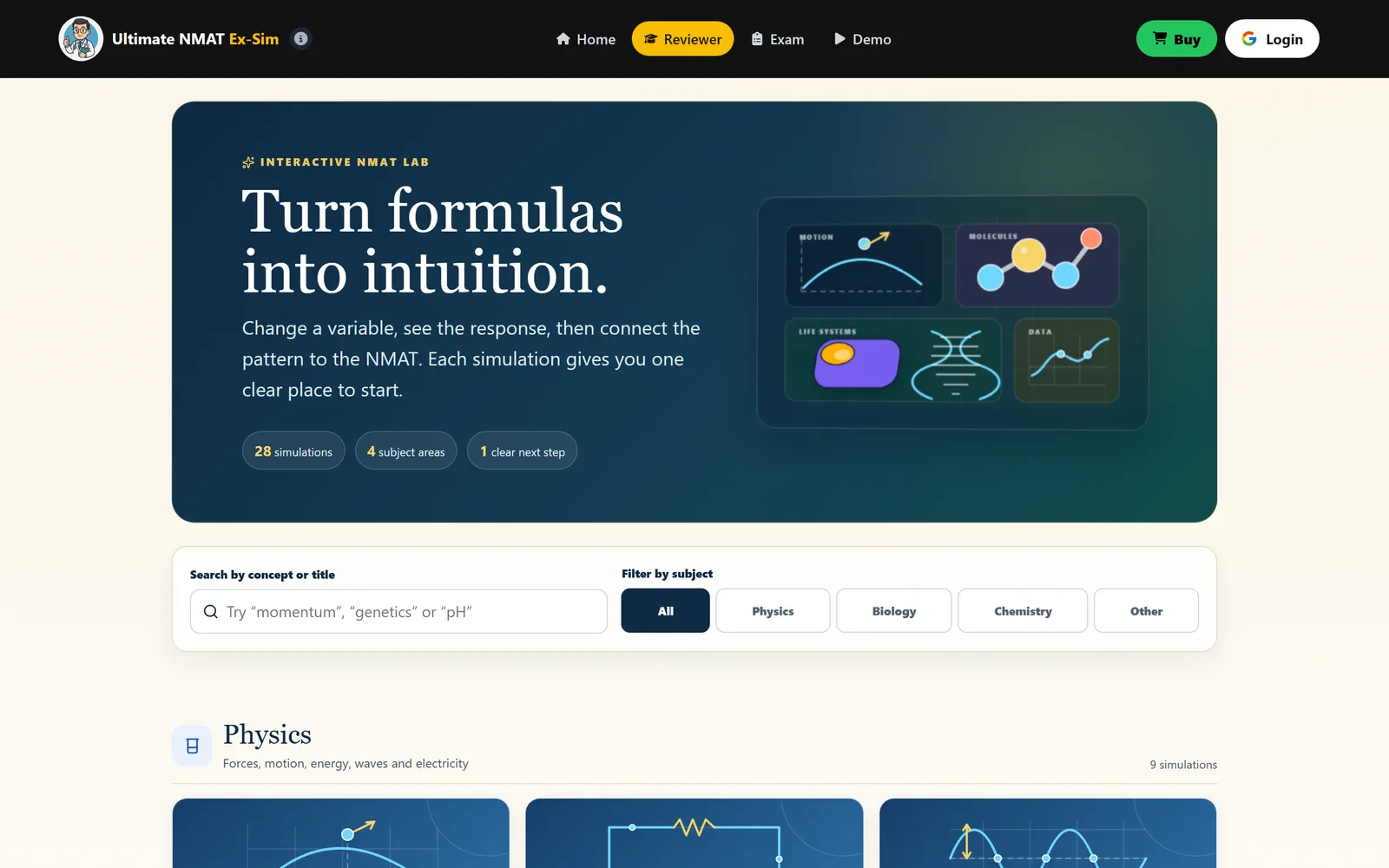
Beside the exams are eight drill tracks and a reviewer at /learn/. Pricing is on the pricing page.
Frequently asked questions
Is a free NMAT app enough?
A free app can be enough for content review or a first look at the format. It is rarely enough for rehearsal unless it offers full 240-item exams on a clock, so check that. Use the free tools first and check whether they cover both parts.
Can an app predict my NMAT percentile?
No. A percentile is a ranking against other examinees, which CEM reports after the test. An app can show accuracy, pace and weak subtests. If it promises a percentile, treat that as marketing rather than measurement.
Can I practise on my phone?
Yes, if the app is built for it. Short drills fit a phone well, but do your full-length rehearsals on the device and screen size you plan to use on test day.
Sources
From the publisher
Meet the NMAT clock here first.
Ultimate NMAT is an NMAT simulator: full-length practice exams and subtest drills in all eight NMAT subtests, sat on a clock, with an explanation behind the items instead of a bare answer key.
- 4,670 practice items in all eight NMAT subtests
- nine full-length practice exams (A to I), 2,320 items
- eight subject drill tracks of ten sets each, 2,350 items
- An interactive reviewer and simulation lab beside the question bank
Try the free NMAT simulator demo A short sample in all eight subtests. No account needed.
About this article
Written by the Ultimate NMAT editorial team, who build the Ultimate NMAT Ex-Sim. Exam facts are checked against the Center for Educational Measurement (CEM) test pages and the CHED issuances CEM cites, and every article lists its sources. How we write and check our articles.
First published .