
Guides7-minute readFor pre-med students preparing for the NMAT
What an NMAT simulator is, and why full-length practice changes your percentile
What an NMAT simulator is, what it reproduces from the online test, and how full-length timed practice fits beside a reviewer and a review class.
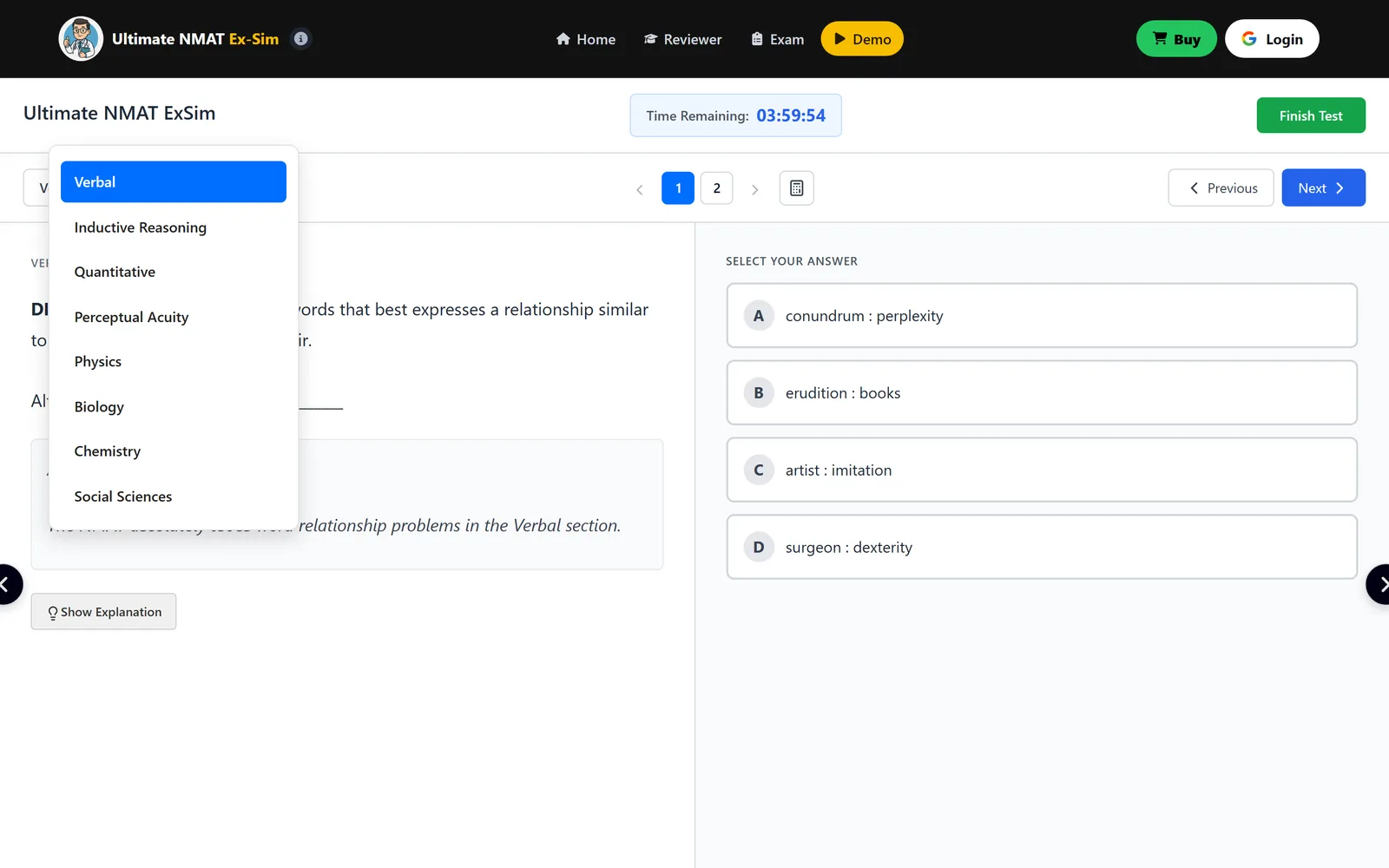
If you are searching for an NMAT simulator, you probably already own notes, a PDF reviewer or a seat in a review class, and you are wondering what is still missing. What is usually missing is a rehearsal: a full sitting of the National Medical Admission Test under the same clock and structure you will face on test day. This guide explains what an NMAT simulator is, what a good one reproduces, and where it fits among the other ways to prepare.
A disclosure first. Ultimate NMAT, which publishes this blog, makes a simulator, so weigh our opinions accordingly. We have tried to be fair to every other study tool, and every exam fact below comes from the Center for Educational Measurement (CEM), which administers the test.
What is an NMAT simulator?
An NMAT simulator is software that reproduces the test-taking experience of the NMAT: the same sections, the same item-by-item screen, the same clocks and the same rule that you work without a physical calculator. It differs from a question list because the structure is enforced. You cannot linger on item 14 because the timer for the whole part keeps running.
The test it imitates is specific. CEM describes the Online NMAT as 240 multiple-choice items with four or five options each, in five sections, split into two parts of 120. Part 1 covers mental ability and Part 2 covers academic proficiency. A simulator that offers 50 mixed questions with no clock is a practice set, which is useful, but it is not a simulator.
Most good simulators also give feedback after each item or each sitting: the answer, the reasoning, and a record of where your time went.
Why does the NMAT reward rehearsal?
The NMAT rewards rehearsal because its constraint is time, not difficulty alone. CEM allots 2 hours 15 minutes for Part 1, a 10-minute break, and 1 hour 30 minutes for Part 2. That works out to roughly 67.5 seconds per item in Part 1 and exactly 45 seconds per item in Part 2, before any time spent on a hard item.
Two things follow. First, a concept you "know" can still cost you points if recall takes 90 seconds. Second, stamina matters: the test runs for hours on a screen, and your accuracy in the last 30 items of Part 2 depends on how well you have practised being tired.
Rehearsal also removes surprises. Reviewees who have never seen the subtest menu, the item layout or the end-of-part screen spend the first minutes of the real test adjusting. Those minutes are better spent answering. Our guide to pacing 240 items across two parts turns the arithmetic into checkpoints.
What should a good NMAT simulator reproduce?
A good simulator reproduces six things, and you can check each one in a few minutes. The table below lists them with the NMAT fact each one imitates.
| What to check | NMAT fact it should match | How to verify |
|---|---|---|
| Two-part structure | 120 items in Part 1, 120 in Part 2, with a break | Look for a full exam with two parts |
| Part clocks | 2 h 15 min and 1 h 30 min | Start a full exam and read the timer |
| All eight subtests | Verbal, Inductive Reasoning, Quantitative, Perceptual Acuity, Biology, Chemistry, Physics, Social Science | Open the subtest menu |
| Figure-based items | Perceptual acuity and figural series | Try an Inductive Reasoning item |
| No physical calculator | Physical calculators are prohibited | Do the Quantitative items by hand |
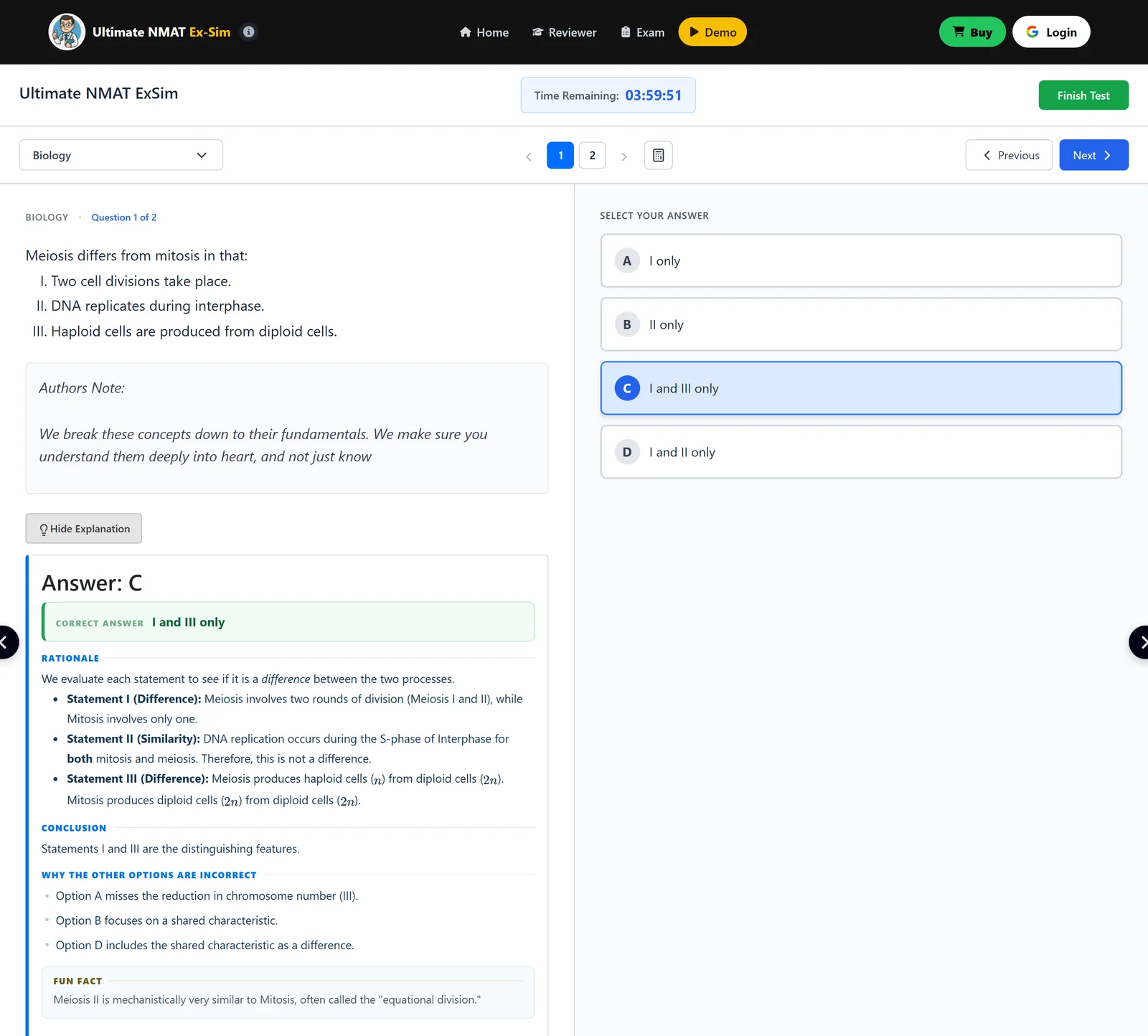
| Explanations | Reasoning behind the answer | Open one after answering |
The last four rows matter more than people expect. Perceptual acuity, which CEM describes as hidden figures, mirror images and identical information, cannot be rehearsed from a text-only PDF. Quantitative items, which cover fundamental operations, problem solving and data interpretation, need to be practised without a physical calculator, which the test-day instructions prohibit.
How does a simulator differ from a reviewer and a review class?
A simulator trains performance, a reviewer rebuilds content, and a review class adds structure and a cohort. Each does a different job, and most reviewees who do well use more than one. The table shows what each tool trains.
| Tool | Best at | Weak at |
|---|---|---|
| Reviewer (book, PDF or lessons) | Rebuilding content you forgot | Pace, stamina, the two-part structure |
| Review class | Schedule, accountability, live explanation | Individual pacing and repeated full sittings |
| Simulator | Pace, stamina, format familiarity, error data | Teaching a concept from scratch |
| Subtest drills | Fixing one weak area quickly | Mixed-subtest stamina |
If you can only add one thing to what you already own, add the missing job. Someone who has read every chapter but never sat a timed part needs a simulator. Someone who sits timed parts but keeps missing the same Chemistry concepts needs a reviewer. We compare the two more closely in NMAT reviewer vs simulator, and the class option in review center or self review.
What does Ultimate NMAT include?
Ultimate NMAT includes nine full-length practice exams (A to I) with 2,320 items between them, and eight subject drill tracks of ten sets each, 2,350 items in all. Explanations accompany most of the 4,670 items, though not all of them.
Two vintages exist inside the full exams. Exams E to I follow the current 240-item format. Exams A to D follow an older 280-item format and are kept as extra practice, so use E to I for your timed rehearsals.
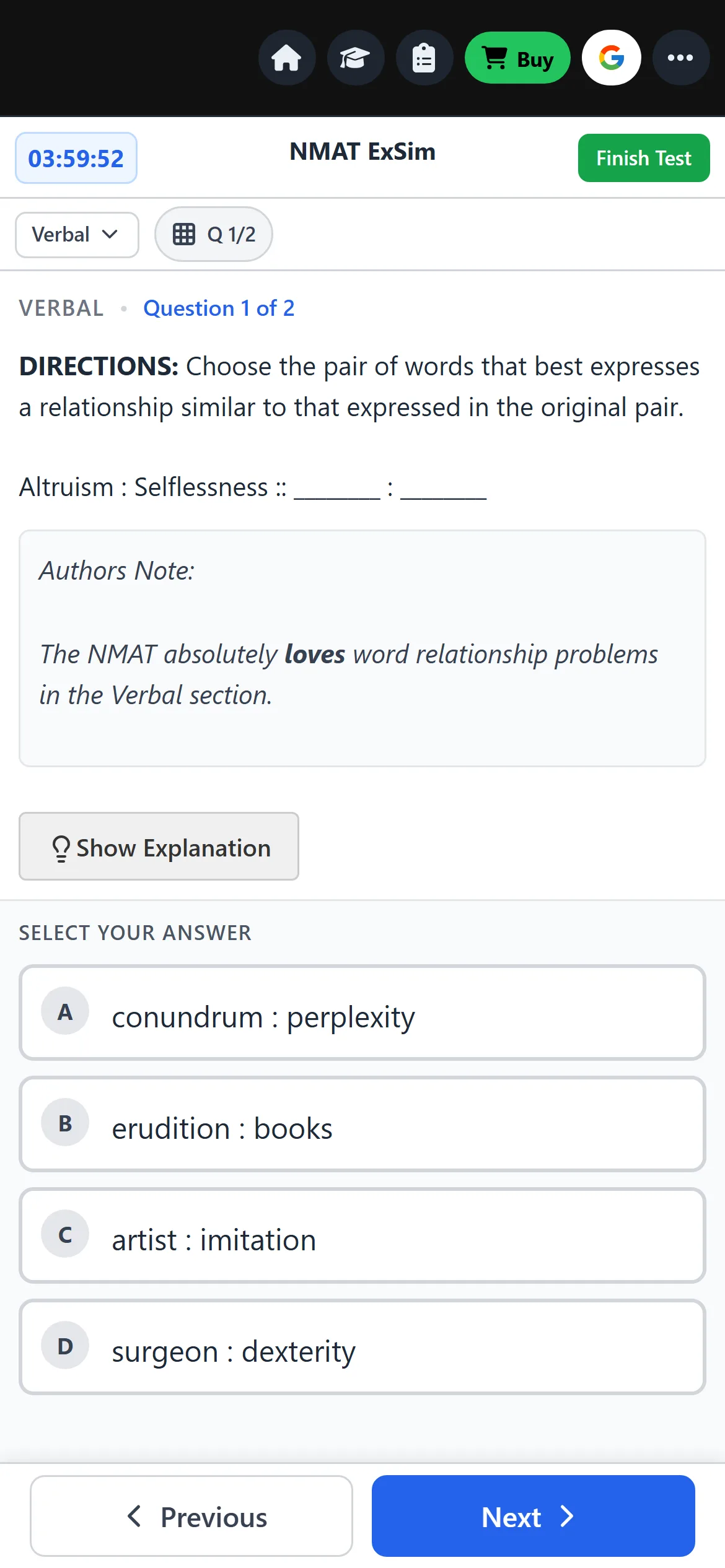
Beside the question bank sits a reviewer at /learn/ with 26 chapters, 161 lessons and 28 simulations; some lessons and the simulation detail pages need a login. You can try the free demo, which has 19 items across all eight subtests and needs no account. Pricing lives on the pricing page, because prices change.
How do you use a simulator across your prep?
Use a simulator at three points: a baseline early, drills in the middle, and rehearsals at the end. The sequence matters more than the total number of questions you do.
- Baseline (first week). Sit one full exam cold. Do not study first. The result tells you which subtests cost you time and which cost you accuracy.
- Repair (middle weeks). Use subtest drills on your weakest areas, and read every explanation, including for items you got right by guessing. Our question review method shows how to log errors.
- Rehearsal (last two to three weeks). Sit full exams in the real order: Part 1, a 10-minute break, Part 2. Use the same room, device and webcam position you plan to use on test day.
A week-by-week version is in our 8-week study plan.
When should you start?
Start with a baseline as soon as you have decided to take the NMAT, and start serious rehearsal about three weeks before your test date. CEM's online administrations are typically scheduled in October to November, January to February, and April to May, so work backwards from the window you are targeting and confirm exact dates with CEM.
Score validity also affects timing. CEM states that the NMAT must be taken not more than two years from the time of admission to medical school, with a percentile equivalent to or higher than the one prescribed by the school or the Commission on Higher Education, whichever is higher. A score taken too early may lapse before you enrol.
If you are still in college, see our guide to taking the NMAT while still in college.
Frequently asked questions
Is there a free NMAT simulator?
Yes, in the sense of a free sample. The Ultimate NMAT demo gives you a short set of items across all eight subtests with no account, so you can check the layout, the timer and the explanations. For what the full-length exams and drill tracks include and how to get them, see the pricing page.
Is the NMAT pass or fail?
No. The NMAT is an admission test, not a licensure exam, and results are reported as percentile ranks. A medical school requires a percentile not lower than the one prescribed by the school or CHED, whichever is higher, so ask your target school what it expects.
When should I start using an NMAT simulator?
Take one full exam as a baseline in your first week of preparation, then return to full-length practice in the last two to three weeks. In between, use subtest drills and a reviewer to repair what the baseline exposed. A simulator is most useful when it is spaced out, not crammed.
Can a simulator predict my percentile?
No. A simulator can show your accuracy, your pace and your weak subtests, but a percentile is a ranking against other examinees that CEM computes. Be cautious of any tool that promises one.
Sources
From the publisher
Meet the NMAT clock here first.
Ultimate NMAT is an NMAT simulator: full-length practice exams and subtest drills in all eight NMAT subtests, sat on a clock, with an explanation behind the items instead of a bare answer key.
- 4,670 practice items in all eight NMAT subtests
- nine full-length practice exams (A to I), 2,320 items
- eight subject drill tracks of ten sets each, 2,350 items
- An interactive reviewer and simulation lab beside the question bank
Try the free NMAT simulator demo A short sample in all eight subtests. No account needed.
About this article
Written by the Ultimate NMAT editorial team, who build the Ultimate NMAT Ex-Sim. Exam facts are checked against the Center for Educational Measurement (CEM) test pages and the CHED issuances CEM cites, and every article lists its sources. How we write and check our articles.
First published .