
Your situation7-minute readFor career shifters applying to medicine
The NMAT for career shifters: getting back into test mode
NMAT for career shifters: how nurses, medtechs and other professionals rebuild test speed, refresh the sciences and plan prep around a working schedule.
You have a career, maybe in nursing, medical technology or another field, and you want to go to medical school. The sciences may feel familiar from work, or distant after years away. This post covers the NMAT for career shifters: what changes after time away, how to rebuild speed and how to fit preparation around a job.
The NMAT is an admission test. CEM reports results as percentile ranks, and each medical school sets the percentile it requires within CHED's rules. We cover what CEM publishes and say plainly where you must check with CEM or the school.
What changes when you have been away from school?
Test speed fades first, and the habit of reading fast under a clock fades with it. Your knowledge may be better than you fear, but the format is unforgiving. CEM describes the online NMAT as 240 multiple-choice items in two parts of 120, with Part 1 at 2 hours 15 minutes and Part 2 at 1 hour 30 minutes (CEM test description).
That is about 67 seconds an item in Part 1 and about 45 seconds in Part 2 on average. Someone who has spent years reasoning through patient problems at their own pace can find 45 seconds a shock.
Also expect subtests that your work did not train. Perceptual Acuity (hidden figures, mirror images, identical information) and Inductive Reasoning (number, letter and figural series) are puzzle-like skills. Social Science covers psychology, sociology and anthropology. Take a baseline full exam in your first week, so the gaps show up as data, not as worry.
How do you rebuild test speed?
Rebuild speed with short, timed sets every day, then a full exam every second week. Speed is a habit, and a habit needs frequent, small practice.
Start untimed for two or three days to relearn the item styles, then time everything. Use the real pace as a target: roughly one item a minute in Part 1 and a little under one every 45 seconds in Part 2. Count a set as finished only when you have reviewed each miss and noted why you missed it.
Ultimate NMAT has eight subject drill tracks of ten sets each, plus nine full practice exams. Explanations accompany most of the 4,670 items, which matters when you are relearning styles you have not seen for years. Our question review method shows how to log errors without wasting time.
What does NMAT for career shifters ask beyond work experience?
Your work gives you real strengths, and it leaves specific gaps the NMAT will test. The table lists common pairings. These are general observations, not claims about every profession.
| Strength from work | Possible NMAT gap | Fix |
|---|---|---|
| Clinical or laboratory vocabulary | Fast recall of Physics and Chemistry fundamentals | Short daily recall sets, then timed drills |
| Careful reading of charts and reports | Speed on Verbal analogies and reading passages | Timed passages with a clock visible |
| Comfort with routine calculations | Mental arithmetic with no physical calculator | A 10-minute no-calculator drill each day |
| Good judgment under pressure | Pattern puzzles in Inductive Reasoning and Perceptual Acuity | Drill the series types by subtest |
| Understanding of people | The formal terms in Social Science | Learn the vocabulary of psychology, sociology and anthropology |
CEM states that physical calculators are prohibited at the test (CEM test-day instructions). Anyone used to a calculator at work should drill mental maths from day one.
How do you refresh the sciences?
Refresh the sciences by topic, in short lessons, then test each topic the same day. Part 2 covers Biology, Chemistry, Physics and Social Science, so those four subjects need a plan (CEM test description).
Start with the subject you used least in your career. A nurse may be strong in physiology but rusty in physics. A medical technologist may know laboratory chemistry but need to recover genetics and ecology. Use the reviewer for the lesson and a drill for proof. Our guide to NMAT Part 2 breaks down each science.
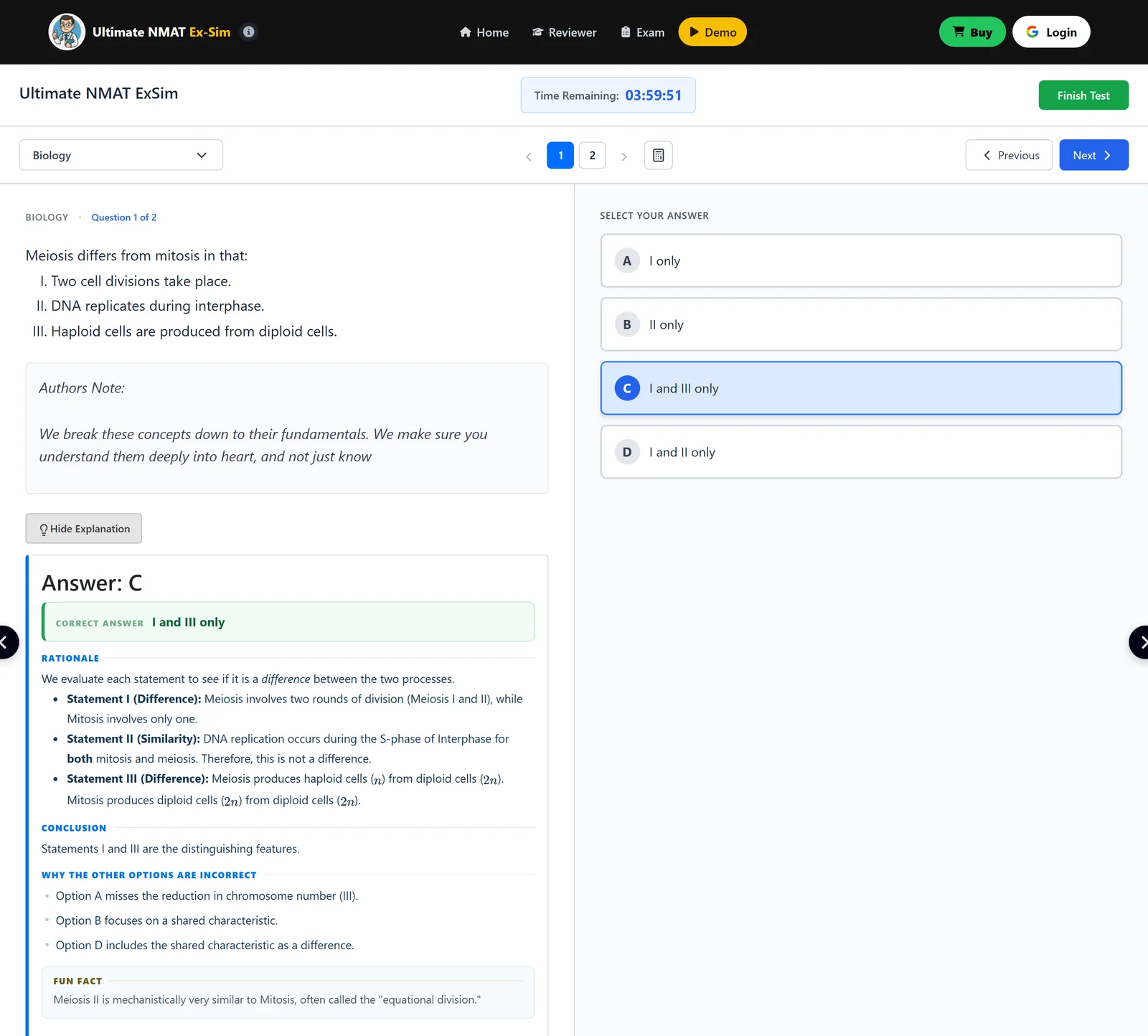
The explanation view below shows how a Biology item can teach as well as score: it walks through each statement and says why the other options fail.
Do not rebuild every chapter before you time yourself. Test first, then study what the test exposes.
How do you plan prep around a working schedule?
Plan around work with 45 to 60 minutes on workdays and one longer session on your day off. Ten to twelve weeks is a sensible length for most people returning after years, though the right length depends on your baseline. Our 8-week study plan gives the structure, and you can stretch each phase.
A sample week for a shift worker: three weekday blocks of a timed drill plus review, one block on an off day for a half-length mixed session, and one rest day. Every second week, replace the long block with a full exam in one sitting, with the 10-minute break between parts.
Be honest about exhaustion. A nightshift block after a twelve-hour shift teaches little. Move study to a better hour, even if it is shorter.
How do you time your application?
Time your application by working back from school deadlines, the registration windows and the two-year validity. CEM says the NMAT must be taken not more than two years from the time of admission to medical school (CEM eligibility page). Online administrations are typically scheduled October to November, January to February and April to May (CEM background page).
Also allow for results. The mailed ERF arrives after six weeks from the last test date, and the electronic copy is not valid for admission. If you need to give notice at work or arrange leave for test day, do it early.
Eligibility and admission rules for graduates of other degrees are set by CEM and the school. Ask both. Our percentile guide explains what schools look for. You can see the exam room in the free demo before committing.
What if the first practice exam goes badly?
A poor first score after years away is normal, and it is information, not a verdict. Your baseline shows which subtests need rebuilding and how far pace is from the real clock. Many returning takers find the first full exam humbling because they run out of time in Part 2, where the average is about 45 seconds an item.
Write down three things straight after the exam: where you ran short of time, which subtests felt unfamiliar and which misses were careless. Those three notes decide your first two weeks. Then repeat the exam after a month and compare, subtest by subtest, instead of looking only at the total.
If the gap is large, extend your plan and move to a later window rather than sitting early. Our 8-week plan can be stretched, and a later sitting costs less than a rushed second attempt.
Do you need to tell your employer?
Plan leave early, because the sitting lasts about four hours in one block and the online rules do not allow you to step away. CEM requires the webcam and microphone to stay on, and leaving the room is prohibited (CEM test-day instructions). A lunch-hour sitting is not realistic.
You do not need to share your reasons if you prefer privacy; a day of leave is enough. If you work shifts, ask for the day before the test to be free as well, so you start rested. Also ask about leave for the weeks around your application, when school interviews or document requests may arrive. Taking care of these small logistics early protects the study hours you have worked hard to build.
Frequently asked questions
Can non-science graduates take the NMAT?
CEM's eligibility page lists college graduates among those who may take the NMAT, but it does not describe course prerequisites. Medical schools set their own admission requirements, so check with CEM and with each school before you register.
Is age a factor for career shifters?
We found no age rule on the CEM pages we could open. A school may have its own policy. Ask each school directly and keep the reply in writing.
How long should I prepare?
Many returning takers need more than a fresh graduate, because they rebuild both pace and content. Ten to twelve weeks around work is a reasonable starting point. A baseline full exam in week one tells you whether to extend.
Will my professional experience help on the test?
It helps your context and judgment, but the NMAT tests eight specific subtests under a clock. Experience does not replace timed practice in Perceptual Acuity, Inductive Reasoning or Social Science.
Sources
- Brief Description of the Test — Center for Educational Measurement
- Eligibility and Registration Requirements — Center for Educational Measurement
- Test Day Instructions — Center for Educational Measurement
- Background of the NMAT — Center for Educational Measurement
- Results release — Center for Educational Measurement
From the publisher
Meet the NMAT clock here first.
Ultimate NMAT is an NMAT simulator: full-length practice exams and subtest drills in all eight NMAT subtests, sat on a clock, with an explanation behind the items instead of a bare answer key.
- 4,670 practice items in all eight NMAT subtests
- nine full-length practice exams (A to I), 2,320 items
- eight subject drill tracks of ten sets each, 2,350 items
- An interactive reviewer and simulation lab beside the question bank
Try the free NMAT simulator demo A short sample in all eight subtests. No account needed.
About this article
Written by the Ultimate NMAT editorial team, who build the Ultimate NMAT Ex-Sim. Exam facts are checked against the Center for Educational Measurement (CEM) test pages and the CHED issuances CEM cites, and every article lists its sources. How we write and check our articles.
First published .