
Study strategy6-minute readFor takers who run out of time
NMAT time management: pacing 240 items across two parts
NMAT time management starts with two numbers: 67.5 seconds an item in Part 1 and 45 in Part 2. Checkpoints, skipping rules and how to train pace.
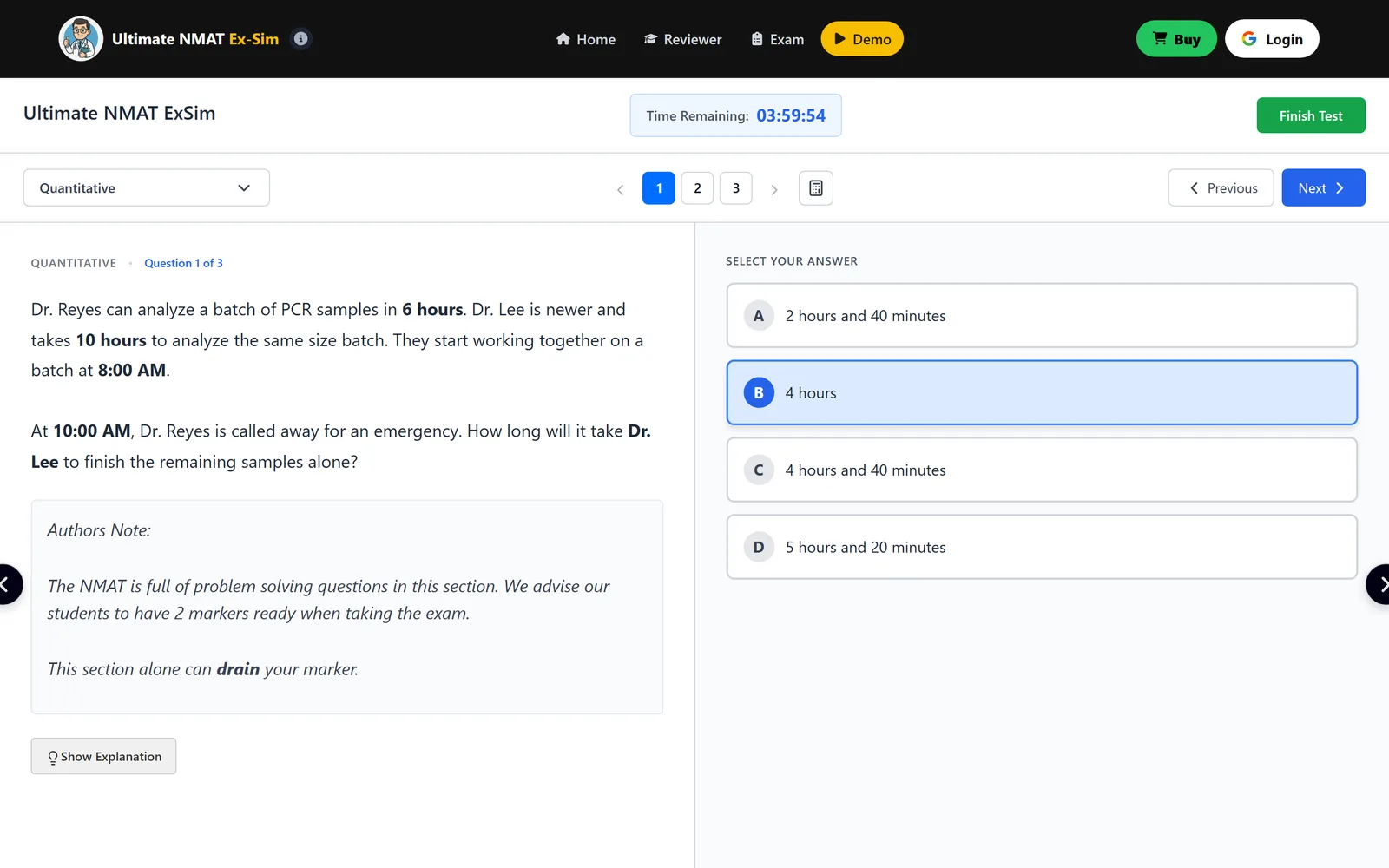
NMAT time management is mostly arithmetic, and the arithmetic is short. Part 1 gives you 67.5 seconds an item on average. Part 2 gives you 45. If you treat both parts alike, one of them will run out before you do.
This post works from the times the Center for Educational Measurement (CEM) publishes and nothing else. We turn them into per-item averages, checkpoints, a rule for skipping, and a way to train the pace. We do not claim any speed makes a given percentile, because it does not work that way.
What is the arithmetic behind NMAT time management?
CEM's brief description of the test gives Part 1 as 2 h 15 min and Part 2 as 1 h 30 min, with 120 items in each part (CEM, Brief Description of the Test). Dividing time by items gives the averages.
| Part | Time | Minutes | Items | Average per item |
|---|---|---|---|---|
| Part 1 | 2 h 15 min | 135 | 120 | 67.5 seconds |
| Part 2 | 1 h 30 min | 90 | 120 | 45 seconds |
Check it: 135 minutes is 8,100 seconds, and 8,100 divided by 120 is 67.5. Ninety minutes is 5,400 seconds, and 5,400 divided by 120 is 45.
An average is not a budget for each item. Some items take 15 seconds and others take two minutes, and the average only works if the quick ones pay for the slow ones. The reminders, the break and the end page sit outside both clocks, so none of them eats into these figures.
How should you pace Part 1?
In Part 1, aim to finish a first pass with a cushion, not at the last second. A first pass at about 62 seconds an item finishes 120 items in 124 minutes, which leaves 11 minutes spare. That spare time is for the items you marked and for any recovery.
Part 1 holds four subtests: Verbal, Inductive Reasoning, Quantitative and Perceptual Acuity. CEM does not publish how many of the 120 items belong to each, so we cannot give a clock per subtest. What we can say is that the subtests do not feel the same:
- Verbal reading comprehension often costs more time than a word analogy.
- Inductive Reasoning series can fall quickly or stall completely.
- Quantitative work has no calculator (see the online rules).
- Perceptual Acuity rewards fast scanning more than deep thought.
Find your own average per subtest from timed practice, then compare it with 67.5 seconds. A subtest that sits well above it is where your time goes.
How should you pace Part 2?
In Part 2, you cannot afford to work most items out from scratch, because 45 seconds is short. Part 2 covers Biology, Physics, Chemistry and Social Science, so the work is mostly recall: either you know it or you do not, and long deliberation rarely helps.
Two practical consequences:
- Read the stem, then answer. Reading every option before forming your own answer wastes seconds.
- Spend your extra time on Physics and Chemistry items that need steps. Recall items in Biology and Social Science should run faster than 45 seconds, which gives time to those that need working.
Be careful with that second point. It is a planning heuristic, not a rule from CEM. Test it on your own timed sets to see if it matches how you work.
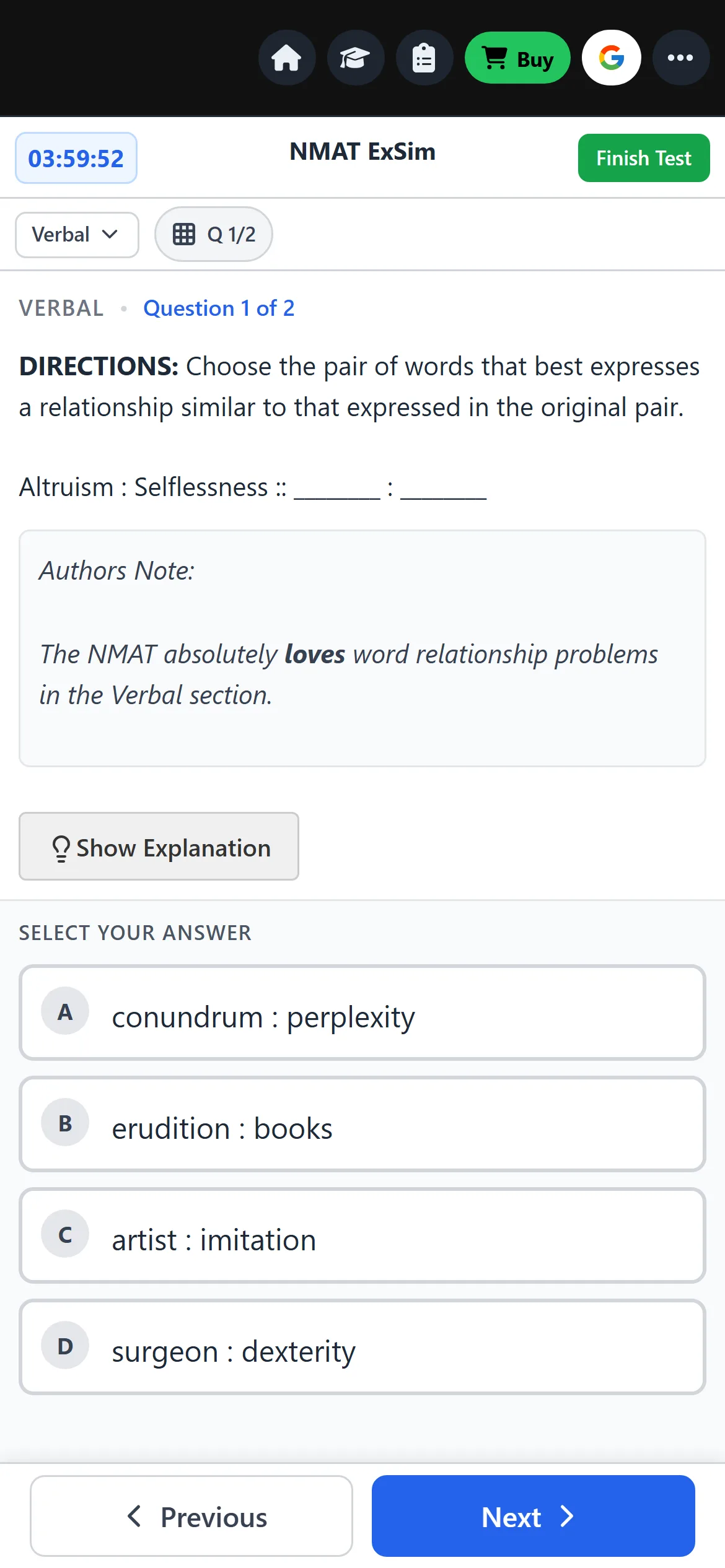
The image below shows our demo on a phone, with the timer in view. The clock is the thing to keep half an eye on, not the thing to stare at. If you want the science side of preparation, our NMAT Part 2 guide covers it.
What checkpoints should you use?
Check the clock every 30 items, not after every item. Looking after each item pulls attention off the question. Four checks per part are enough.
| Items done | Part 1 clock used, even pace | Part 2 clock used, even pace |
|---|---|---|
| 30 | 33 min 45 s | 22 min 30 s |
| 60 | 1 h 07 min 30 s | 45 min |
| 90 | 1 h 41 min 15 s | 1 h 07 min 30 s |
| 120 | 2 h 15 min | 1 h 30 min |
These are even-pace figures, built from 67.5 and 45 seconds. If you want a cushion for review, shift every checkpoint earlier. For example, a 10-minute cushion in Part 1 means being at item 30 by about 31 minutes.
Behind schedule at a checkpoint? Do not sprint. Pick up about five seconds an item across the next 30 by dropping your slowest habit, such as re-reading stems twice. Ahead of schedule? Bank it and keep the same speed, rather than slowing down to "use" the time.
When should you skip an item?
Skip when an item has taken about twice its share and you have no clear next step. In Part 1 that is roughly two minutes; in Part 2 it is roughly 90 seconds. Make a guess if the format allows, mark the item if you can, and move on.
We cannot tell you from CEM's pages how wrong answers are scored, or exactly how navigation works on the day. Read the current test-day instructions and the Bulletin of Information that CEM links from its NMAT page before you decide how to handle a blank.
Why skip at all? One stubborn item that costs three minutes costs you the time of nearly three average Part 1 items, or four Part 2 items. The trade is rarely worth it. A second look at the end, if you have time and the format allows it, usually goes faster because you are no longer stuck.
Set the skip rule before the test, in practice. Deciding in the moment is when pride gets in the way.
How do you train the pace?
Train at the real pace in real blocks, because pace is learned by repetition. The sequence we suggest:
- Start with untimed sets to learn the method.
- Move to timed sets of 30 items at 67.5 seconds each (33 min 45 s) for Part 1 subtests, and 45 seconds each (22 min 30 s) for Part 2 subtests.
- Join two blocks into a full part: 120 items in 135 minutes, then 120 in 90.
- Finish with a full sitting: Part 1, a 10-minute break, then Part 2.
Ultimate NMAT has nine full practice exams. Exams E to I follow the current 240-item format, and A to D are an older 280-item format kept for extra practice. There are also eight subject drill tracks of ten sets each, so you can drill your slowest subtest. Explanations accompany most items, which helps you learn why a slow item was slow.
The free demo shows the clock and the subtest menu with no account. Pair pace work with calm: if the clock tightens your chest, see our post on NMAT anxiety, and for the shape of each part, our NMAT format guide.
Frequently asked questions
How many seconds do you get per item on the NMAT?
On average, 67.5 seconds in Part 1 and 45 seconds in Part 2. Part 1 gives 135 minutes for 120 items, and Part 2 gives 90 minutes for 120 items, according to the Center for Educational Measurement (CEM). These are averages, not a limit per item.
Is there a break between the two parts?
Yes. CEM's schedule includes a 10-minute break between Part 1 and Part 2. It sits outside both part clocks. Use it to stand, drink water and reset, not to study.
Should you answer the NMAT in order?
Start in order, because it is the simplest habit, and skip an item that has taken about twice its share. Check CEM's current test-day instructions for how navigation and flagging work on the day, since we cannot confirm those details from the pages we reviewed.
Does finishing early help your percentile?
Not by itself. Finishing with time left lets you revisit items, but the percentile depends on how many items you answer correctly relative to other examinees. Pace is a means to answer everything you can, not a score in its own right.
Sources
From the publisher
Meet the NMAT clock here first.
Ultimate NMAT is an NMAT simulator: full-length practice exams and subtest drills in all eight NMAT subtests, sat on a clock, with an explanation behind the items instead of a bare answer key.
- 4,670 practice items in all eight NMAT subtests
- nine full-length practice exams (A to I), 2,320 items
- eight subject drill tracks of ten sets each, 2,350 items
- An interactive reviewer and simulation lab beside the question bank
Try the free NMAT simulator demo A short sample in all eight subtests. No account needed.
About this article
Written by the Ultimate NMAT editorial team, who build the Ultimate NMAT Ex-Sim. Exam facts are checked against the Center for Educational Measurement (CEM) test pages and the CHED issuances CEM cites, and every article lists its sources. How we write and check our articles.
First published .