
Study strategy7-minute readFor takers rusty on mental maths
NMAT quantitative without a calculator: mental maths that saves seconds
Build NMAT quantitative speed without a calculator: fraction-percent facts, ratio shortcuts, estimation and five checked worked examples with a daily drill.
Most pre-meds can do the arithmetic in NMAT quantitative. The trouble is doing it with no calculator, on a clock, with a live proctor watching. Skills that felt automatic with a device in your hand turn out to be slow when you have to do them in your head.
This guide gives you the techniques that save the most seconds: fraction-percent facts, ratio habits, estimation and cancelling. It includes worked examples of our own, each checked twice. They teach methods and are not predictions of any particular item.
Why does no-calculator maths matter on the NMAT?
No-calculator maths matters because the Center for Educational Measurement (CEM) lists physical calculators among the items prohibited during the online test. Quantitative is one of the four Part 1 subtests, covering fundamental operations, problem solving and data interpretation, according to CEM's description of the test.
Part 1 has 120 items in 2 hours 15 minutes, an average of about 67.5 seconds an item. Quantitative items compete with reading passages and series for that time. If a routine percentage costs you 40 seconds, the cost is paid by another item later.
The good news is that arithmetic speed responds well to practice. You are not learning new mathematics. You are making old facts instant, and choosing the shortest path through each problem.
We cover the whole proctoring setup in our guide to the online NMAT rules, so here we stay with the maths.
Which fractions and percentages should you know by heart?
Know about a dozen fraction-percent pairs instantly, because most percentage, ratio and data items reduce to one of them. Build the rest from three anchors: 10%, 50% and 1/8 = 12.5%.
| Fraction | Percent | Trick |
|---|---|---|
| 1/2 | 50% | Halve it |
| 1/3 | 33.3% | Divide by 3 |
| 2/3 | 66.7% | Double one third |
| 1/4 | 25% | Halve twice |
| 3/4 | 75% | Subtract one quarter |
| 1/5 | 20% | Divide by 10, then double |
| 1/6 | 16.7% | Half of one third |
| 1/8 | 12.5% | Halve three times |
| 3/8 | 37.5% | Three times 12.5% |
| 5/8 | 62.5% | Half plus 12.5% |
| 7/8 | 87.5% | 100% minus 12.5% |
| 1/9 | 11.1% | Divide by 9 |
| 1/12 | 8.3% | Half of one sixth |
To find any percentage, split it into 10%, 5% and 1%. For 15% of 240, take 10% (24) and 5% (12), which gives 36. For 12.5% of 480, take one eighth: 480 ÷ 8 = 60. Practise until the pairs come out as fast as your own phone number.
How do ratios and proportions work mentally?
Ratio problems become easy when you find the value of one part first and then multiply. Add the ratio numbers to get the total parts, divide the total by that count, and scale up. This single habit covers mixtures, shares and many word problems.
Suppose a solution is mixed in the ratio 3:5 and the total volume is 40 mL. The parts add to 3 + 5 = 8, so one part is 40 ÷ 8 = 5 mL. The two components are 3 × 5 = 15 mL and 5 × 5 = 25 mL, and 15 + 25 = 40 confirms it.
For proportions, cross-check by scaling both sides. If 4 tablets contain 600 mg in total, 6 tablets contain 900 mg, because you can find 1 tablet (150 mg) or scale by 6/4 = 1.5. Choose whichever is cleaner.
Units deserve a pause. To change 72 km/h to m/s, divide by 3.6, which gives 20 m/s. The conversion factor works because 1 km/h = 1000 m ÷ 3600 s = 0.2777... m/s, so dividing by 3.6 is the same as multiplying by that.
How do you estimate and eliminate options?
Estimate by rounding to friendly numbers, then eliminate options that are too far away, and calculate exactly only if two options stay close. Estimation is safe when the options are spread out and unsafe when they are close together, so glance at the options first.
Here is a case: what is 49.2% of 398, given options 156, 196, 236 and 276? Round 49.2% to 50% and 398 to 400. Half of 400 is 200, and only 196 sits near 200. The exact value is 398 × 0.492 = 199 − 3.184 = 195.816, which rounds to 196. The estimate got there in about five seconds.
The reverse check is just as useful. If your exact answer lies far from the estimate, you made a slip. A result that is ten times too big or too small usually means a misplaced decimal point.
If two options differ by only a small amount, estimation will not separate them. Then switch to exact calculation, or compare the last digits of the options with the last digit of your answer.
What do worked examples of NMAT quantitative look like?
Worked examples show the method in full, so you can copy the habit. Each below is our own, and the arithmetic is checked in the last line.
Example 1: percent change. A count rises from 80 to 100. The increase is 20, and 20 ÷ 80 = 1/4 = 25%. Now the reverse: the count falls from 100 to 80. The decrease is 20, and 20 ÷ 100 = 20%. The two percentages differ because the base changed, a classic trap.
Example 2: cancel before multiplying. Find (18 × 35) ÷ (21 × 6). Pair 18 with 6 to get 3, and 35 with 21 to get 5/3. Then 3 × 5/3 = 5. The long way gives 630 ÷ 126 = 5.
Example 3: a square near a round number. Find 35². Use the pattern for numbers ending in 5: multiply the tens digit by the next integer (3 × 4 = 12) and attach 25, giving 1225. Check: 35 × 35 = 1050 + 175 = 1225.
Example 4: distribute. Find 47 × 6. Split 47 into 40 + 7: 240 + 42 = 282.
How do you solve a work-rate problem step by step?
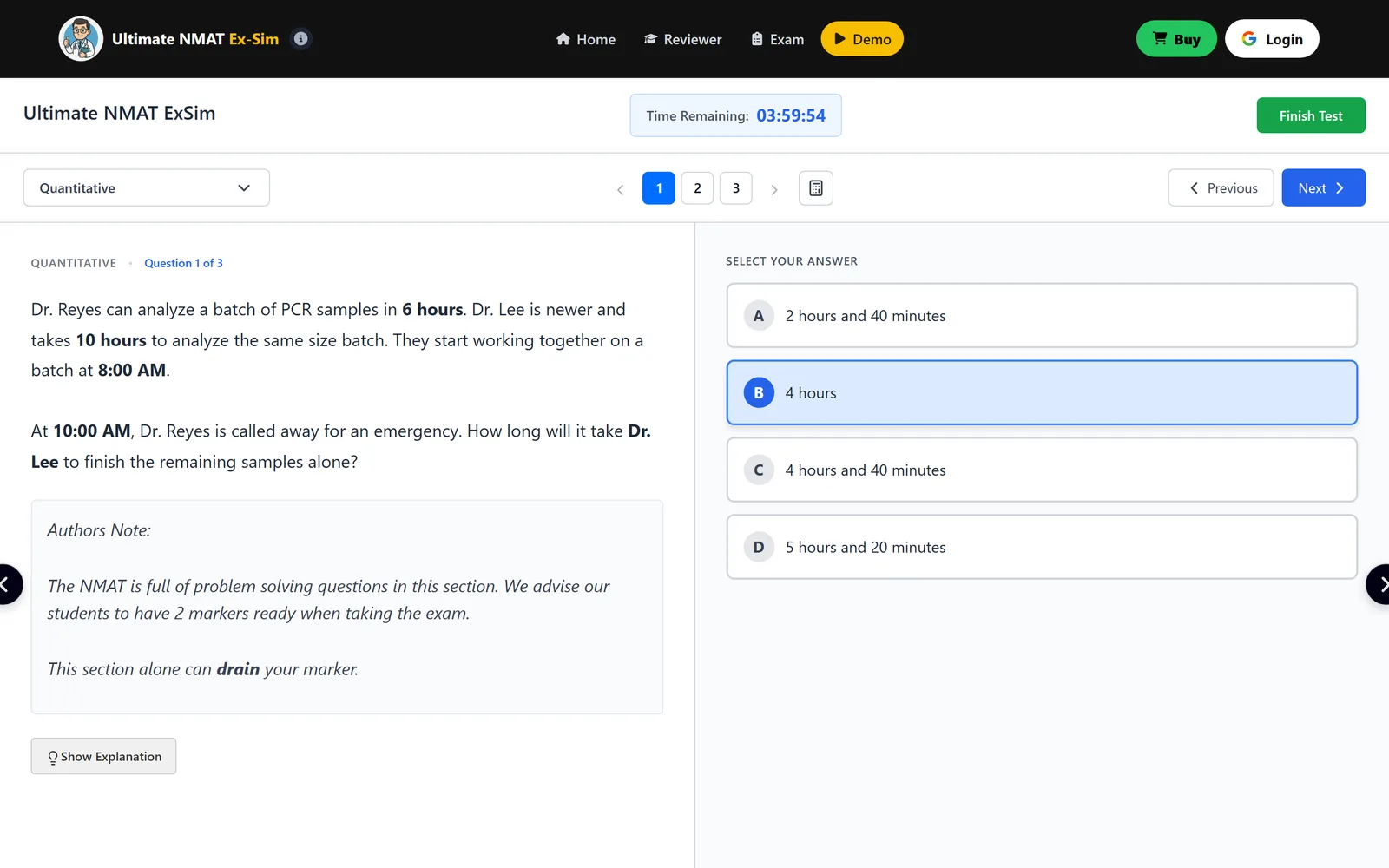
Solve a work-rate problem by converting each person to a rate per hour, adding the rates for the time they work together, and then dividing the remaining work by the remaining worker's rate. This is the pattern in the demo item pictured at the top of this post.
Two analysts take 6 hours and 10 hours to finish one batch. They start together, and the faster analyst leaves after 2 hours. Their rates are 1/6 and 1/10 of a batch per hour. Together that is 1/6 + 1/10 = 5/30 + 3/30 = 8/30 = 4/15 per hour.
In 2 hours they complete 2 × 4/15 = 8/15 of the batch, leaving 1 − 8/15 = 7/15. The slower analyst works at 1/10 per hour, so the remaining time is (7/15) ÷ (1/10) = 70/15 = 14/3 hours. That is 4 hours and 40 minutes (a third of an hour is 20 minutes).
In the screenshot, a practice option is highlighted, but the correct answer to this item is 4 h 40 min. A tempting wrong route is to subtract 2 from 10 and answer 8, forgetting that the faster analyst did part of the work.
What does a 10-minute daily drill look like?
A daily drill should take ten minutes, cover three skills, and end with a check of every answer. Short and regular beats long and rare, because speed fades when you stop.
| Minutes | Block | Example task |
|---|---|---|
| 0–3 | Fraction-percent recall | Say the percent for 1/8, 5/8, 1/12, then the fraction for 37.5% |
| 3–6 | Percent-of and ratio sums | Five quick items such as 15% of 240 or a 3:5 split of 40 |
| 6–9 | One estimation item | Round, eliminate, then verify exactly |
| 9–10 | Check and log | Mark the slips and write the cause |
Do the drill with the clock visible and no device, since that is the condition you will face. Once a week, replace the estimation item with a data-interpretation chart, and read the units before the question. Our time management guide shows how quantitative pacing fits the rest of Part 1, and our Part 1 guide covers the other three subtests. Try timed Quantitative items in the free demo.
Frequently asked questions
Can I use a calculator on the NMAT?
No physical calculator is allowed. CEM's test-day instructions for the online NMAT list physical calculators among prohibited items, alongside phones, notes and other devices. Rules can be updated, so read the current Test Day Instructions before your sitting. Plan your preparation around doing all arithmetic in your head or with approved scratch materials.
How do I get faster at mental maths?
Practise a little every day. Memorise the fraction-percent pairs, learn a few shortcuts such as cancelling and splitting numbers, and time yourself so you can see progress. Check every answer and note why you missed it. Ten focused minutes daily usually beat one long session a week.
Is estimation safe on the NMAT?
Estimation is safe when the options are far apart, and risky when they are close. Look at the options first. If they differ by large steps, rounding will usually identify the answer. If two are near each other, finish the exact calculation or compare the last digits to separate them.
Does the NMAT include data interpretation?
Yes. CEM lists data interpretation as part of the Quantitative subtest, along with fundamental operations and problem solving. Practise reading titles, axes and units before the question, and estimate readings from graphs and tables before doing exact calculations.
Sources
From the publisher
Meet the NMAT clock here first.
Ultimate NMAT is an NMAT simulator: full-length practice exams and subtest drills in all eight NMAT subtests, sat on a clock, with an explanation behind the items instead of a bare answer key.
- 4,670 practice items in all eight NMAT subtests
- nine full-length practice exams (A to I), 2,320 items
- eight subject drill tracks of ten sets each, 2,350 items
- An interactive reviewer and simulation lab beside the question bank
Try the free NMAT simulator demo A short sample in all eight subtests. No account needed.
About this article
Written by the Ultimate NMAT editorial team, who build the Ultimate NMAT Ex-Sim. Exam facts are checked against the Center for Educational Measurement (CEM) test pages and the CHED issuances CEM cites, and every article lists its sources. How we write and check our articles.
First published .