
Guides7-minute readFor students mapping the path to becoming a doctor
NMAT vs PLE: the admission test and the licensure exam, explained
NMAT vs PLE explained: the NMAT gets you into medical school, a licensure exam comes after it. See the sequence, the purpose of each and what carries over.

If you are mapping the road to becoming a doctor, two exam names keep appearing and they sound alike: the NMAT and the PLE. They are not the same kind of test. This post explains NMAT vs PLE in plain terms: what each is for, when you take it, who runs it and what carries over.
We know the NMAT well and publish this blog for a simulator that prepares for it, so weigh our view on that basis. For the licensure exam we say only what is general, because the sources we rely on do not describe it.
NMAT vs PLE: what is the difference?
The NMAT decides who may enter medical school, and a licensure exam decides who may practise after finishing it. One is a gate at the beginning of the path. The other is a gate at the end.
The Center for Educational Measurement (CEM) administers the NMAT, and it is required for admission to Philippine medical schools since school year 1986 to 1987 (CEM background page). It is an admission test, not a licensure exam.
A licensure exam such as the PLE is the physician licensure examination. It is regulated by the Professional Regulation Commission (PRC) and taken after medical school and internship. The two tests have different bodies, different purposes and different times in your life. A strong NMAT percentile helps you get admitted. It says nothing about your licensure.
| Exam | Purpose | When you take it |
|---|---|---|
| NMAT | Admission to a Philippine medical school | Before medical school, as a college graduate or graduating student |
| PLE | Licensure to practise as a physician, under the PRC | After medical school and internship |
What is the NMAT?
The NMAT is an online, multiple-choice admission test with 240 items in two parts of 120. Part 1 covers Verbal, Inductive Reasoning, Quantitative and Perceptual Acuity, and Part 2 covers Biology, Chemistry, Physics and Social Science. Part 1 runs 2 hours 15 minutes, there is a 10-minute break and Part 2 runs 1 hour 30 minutes (CEM test description).
CEM cites CHED Executive Order 285 (2000) and CHED Memorandum Order No. 18 (2016) as part of the legal basis, along with the Medical Act of 1959 and DECS Order No. 52 (1985). Our format and subtests guide goes through each part.
Results are percentile ranks. CEM's rule is that the NMAT must be taken not more than two years from the time of admission to medical school, with a percentile equivalent to or higher than what the school or the Commission prescribes, whichever is higher (CEM eligibility page). That is why there is no passing score on the NMAT, only the percentile each school asks for.
What is the PLE, in one paragraph?
The PLE is the licensure examination for physicians, taken after medical school and internship, and run under the Professional Regulation Commission. That is all we state, because the sources we rely on for this blog cover the NMAT and not the licensure exam.
For its format, subjects, schedule, requirements and results, go to the PRC and your medical school. Do not take figures about it from forums or chatbots, because they change and are often wrong or mixed up with other exams. Even the name causes confusion: other professions have licensure exams too, and the abbreviations can look alike.
What does the path from NMAT to licensure look like?
The path runs in a fixed order: the NMAT, medical school admission, medical school, internship, then a licensure exam. Each step has its own requirements, and each is decided by a different body.
First you sit the NMAT while finishing or after finishing college. CEM mails the official ERF after six weeks, and the electronic copy is not valid for admission (CEM results page). You then apply to schools, and each school applies the percentile it prescribes within the CHED rule.
If you are admitted, you complete the medical program and internship. Only after that does a licensure exam like the PLE come into view. For most students, that is years away. Our percentile guide explains how schools use the NMAT step.
Do NMAT habits carry forward?
Yes, the habits carry forward even though the score does not. The score has one job: admission. Once you are in, no licensure body asks for your NMAT percentile.
What lasts is the way you prepare. Timed practice teaches pacing under pressure, a skill every high-stakes exam rewards. An error log teaches you to separate content gaps from careless slips. Reading explanations after committing to an answer is a durable way to learn medicine, too.
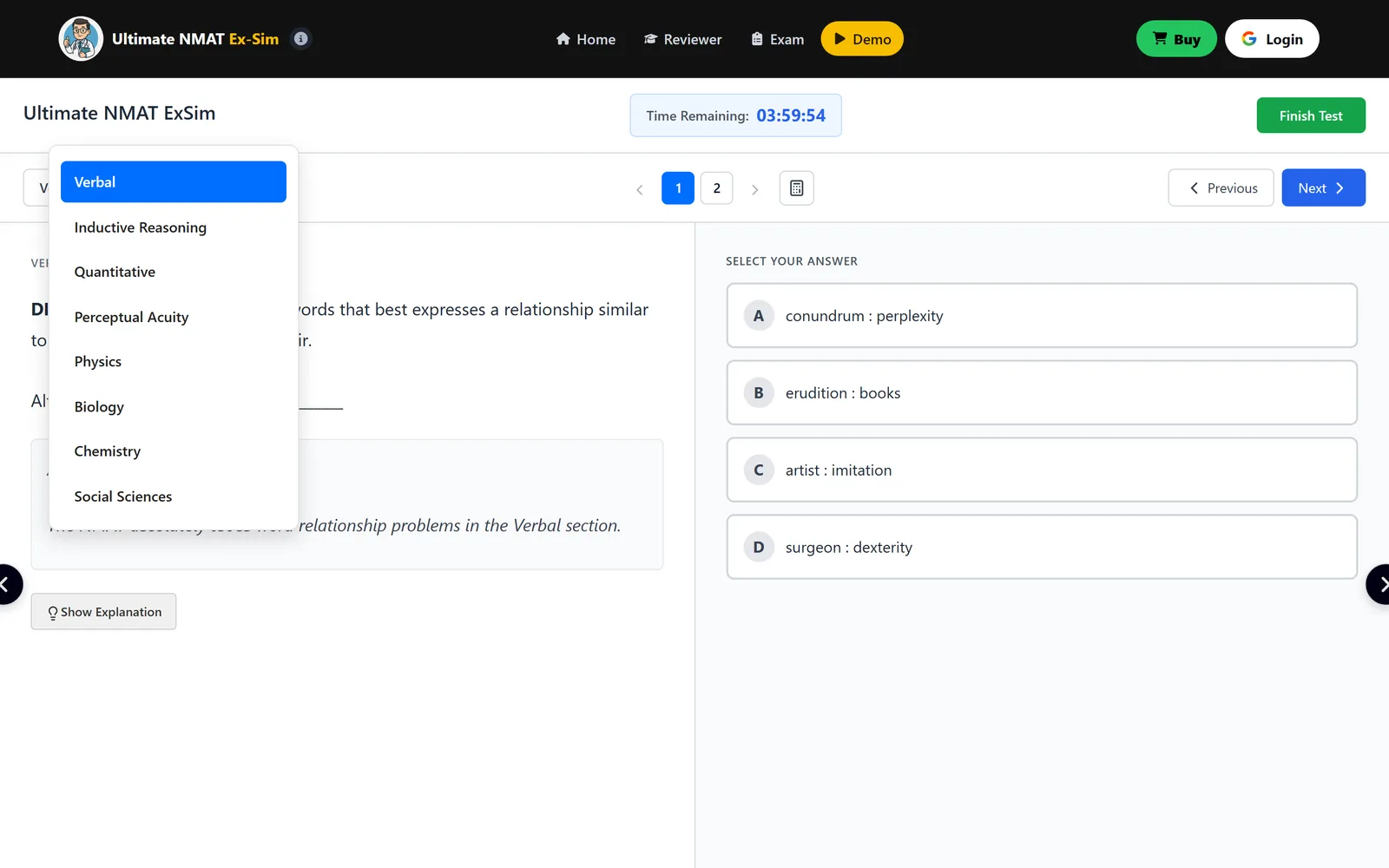
Ultimate NMAT is built around that loop. It has nine full practice exams and eight subject drill tracks, and explanations accompany most of its 4,670 items. Our guide to what an NMAT simulator is describes the approach, and the free demo lets you try it.
Do not borrow the habits of one exam into another blindly, though. A licensure exam has its own content and format, so rebuild your plan around its official material when the time comes.
Why do students mix up the NMAT and the PLE?
Students mix them up because both are called exams, both involve medicine and both come with a lot of advice online. The advice often drifts from one exam to the other, or to a different test entirely.
Three differences settle most confusion. The purpose differs: one admits you to school and the other licenses you after it. The timing differs: one comes before you start medical school, and the other comes years later. The reporting differs: the NMAT is reported in percentile ranks that schools compare with their own requirement, so it has no pass mark, while a licensure exam is a separate system run by the licensing body.
When you read a tip, ask which exam it is about and who published it. A claim about a "passing score" or a "cutoff" needs a named source. Our percentile guide shows how to read NMAT claims carefully.
What should you do now if you are still in college?
If you are still in college, plan for the NMAT today and leave licensure for later. Confirm that you are eligible, choose a window and build a preparation plan. CEM lists college graduates and students graduating at the end of the current school year among those who may take it (CEM eligibility page).
Then look at your target schools. Ask each one what percentile it requires, and what it does with scores from more than one sitting. Build your timeline backwards from their deadlines, remembering the six weeks the ERF takes to arrive.
Leave licensure for later. When you reach the end of medical school, you will have official material, instructors and a cohort to guide that stage. Spending months now on an exam that is years away costs you the preparation that matters this year.
How long is the whole road?
The road is long, and the NMAT is its first checkpoint. College comes first, then the NMAT, admission, the medical program and internship, and finally the licensure exam. Each stage has its own timeline, so plan one stage at a time and ask each school or body for current requirements.
For now, keep your eye on the next gate. A clear plan for the NMAT, with a window, a percentile target from your school and a preparation routine, is a realistic goal for this year.
Frequently asked questions
Is the NMAT a board exam?
No. The NMAT is an admission test taken before medical school, administered by CEM and used by schools for admission. Board or licensure exams come after the degree, under a licensing body.
When do you take the PLE?
Generally, a licensure exam such as the PLE comes after medical school and internship, not before. For dates, requirements and the format, check the Professional Regulation Commission and your school, because this blog does not cover the exam.
Does my NMAT score matter after I am admitted?
For admission only. CEM's rule ties the score to admission, requiring that it be taken not more than two years before admission to medical school. Licensure is a separate step with its own requirements.
Is there a pass or fail on the NMAT?
No. The NMAT is reported in percentile ranks, and each school, within CHED's rule, prescribes the percentile it requires. Ask your target schools for their figures.
Sources
From the publisher
Meet the NMAT clock here first.
Ultimate NMAT is an NMAT simulator: full-length practice exams and subtest drills in all eight NMAT subtests, sat on a clock, with an explanation behind the items instead of a bare answer key.
- 4,670 practice items in all eight NMAT subtests
- nine full-length practice exams (A to I), 2,320 items
- eight subject drill tracks of ten sets each, 2,350 items
- An interactive reviewer and simulation lab beside the question bank
Try the free NMAT simulator demo A short sample in all eight subtests. No account needed.
About this article
Written by the Ultimate NMAT editorial team, who build the Ultimate NMAT Ex-Sim. Exam facts are checked against the Center for Educational Measurement (CEM) test pages and the CHED issuances CEM cites, and every article lists its sources. How we write and check our articles.
First published .