
Study strategy7-minute readFor takers in the final month
NMAT tips for the last 30 days: a week-by-week plan
NMAT tips for the final month: full exams on a schedule, repair of weak subtests, a webcam and room rehearsal, and a calm taper before test day.
If your NMAT is a month away, these NMAT tips will help you spend the time well. You cannot rebuild a whole science in 30 days, but you can sharpen pace, repair your weakest subtests and arrive with a routine you have already rehearsed.
The plan below is built from our own practice advice and from the Center for Educational Measurement (CEM) rules for the online test. It does not promise a percentile. It aims to remove avoidable losses.
What are the most useful NMAT tips for the last month?
The last month is for three jobs: rehearsal, repair and setup. Rehearsal means sitting full timed exams. Repair means fixing the subtests those exams expose. Setup means making sure the online, proctored conditions hold no surprises.
CEM describes the online NMAT as 240 items in two parts of 120: Part 1 in 2 hours 15 minutes, a 10-minute break, then Part 2 in 1 hour 30 minutes. Your stamina and pace for that shape are worth more now than a new chapter.
Stop adding sources. Choose one set of materials and finish it. Switching reviewers in week 3 usually costs time and adds little.
If you have not yet built a longer plan, read our 8-week NMAT study plan and take the last four weeks of it. Everything below assumes you already know roughly where your weak subtests are.
| Week out | Do | Don't |
|---|---|---|
| 4 | Sit a full timed exam, log errors, start repair drills | Start a new reviewer or source |
| 3 | Second full exam, then targeted drills on repeat misses | Study only your favourite subtests |
| 2 | Third full exam, setup rehearsal with webcam and room | Change your routine or device |
| Test week | Light review, sleep, settle your setup | Cram, or sit a full exam in the final two days |
What should week four out look like?
In the fourth week before the test, sit one full exam under real timing, log every error, and spend the rest of the week repairing the subtests that cost you the most. This is your last big diagnostic, so use it fully.
Sit the exam at the hour of day your sitting is likely to start, and take only the 10-minute break between parts. Afterwards, sort every miss into content gap, rushed, misread or arithmetic slip. Our question review method explains the log.
Then drill. Aim two or three short sessions at the subtest that lost the most points, and one at the next worst. Keep all other subtests alive with ten minutes a day.
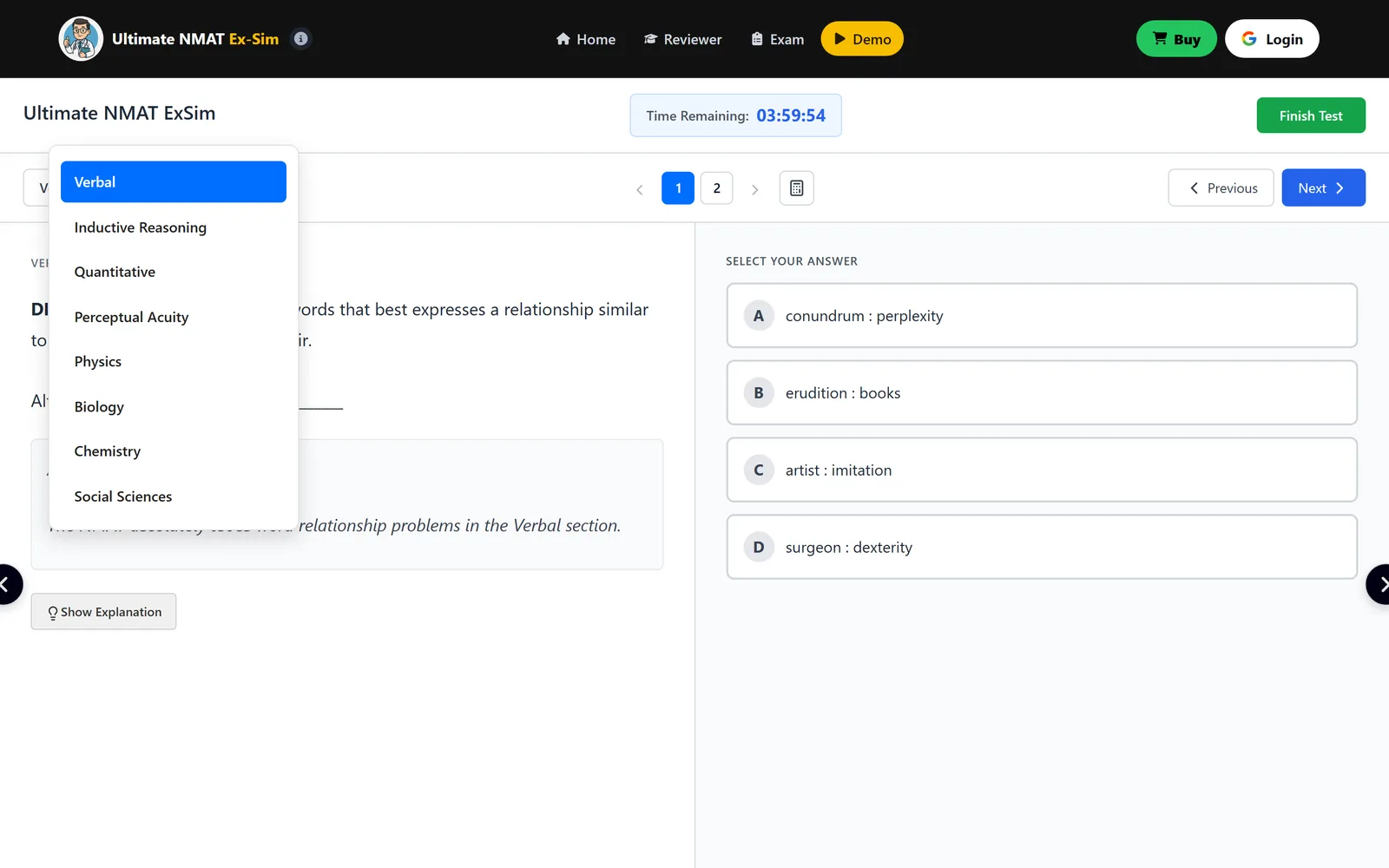
The subtest menu in the demo shows the eight areas you are balancing: Verbal, Inductive Reasoning, Quantitative, Perceptual Acuity, Physics, Biology, Chemistry and Social Sciences. Rotate through them so none goes cold for more than three days.
What should week three out look like?
In the third week out, sit a second full exam, compare it with the first, and use the gap to decide where to repair. The comparison matters more than the raw score: look for subtests that improved and those that did not.
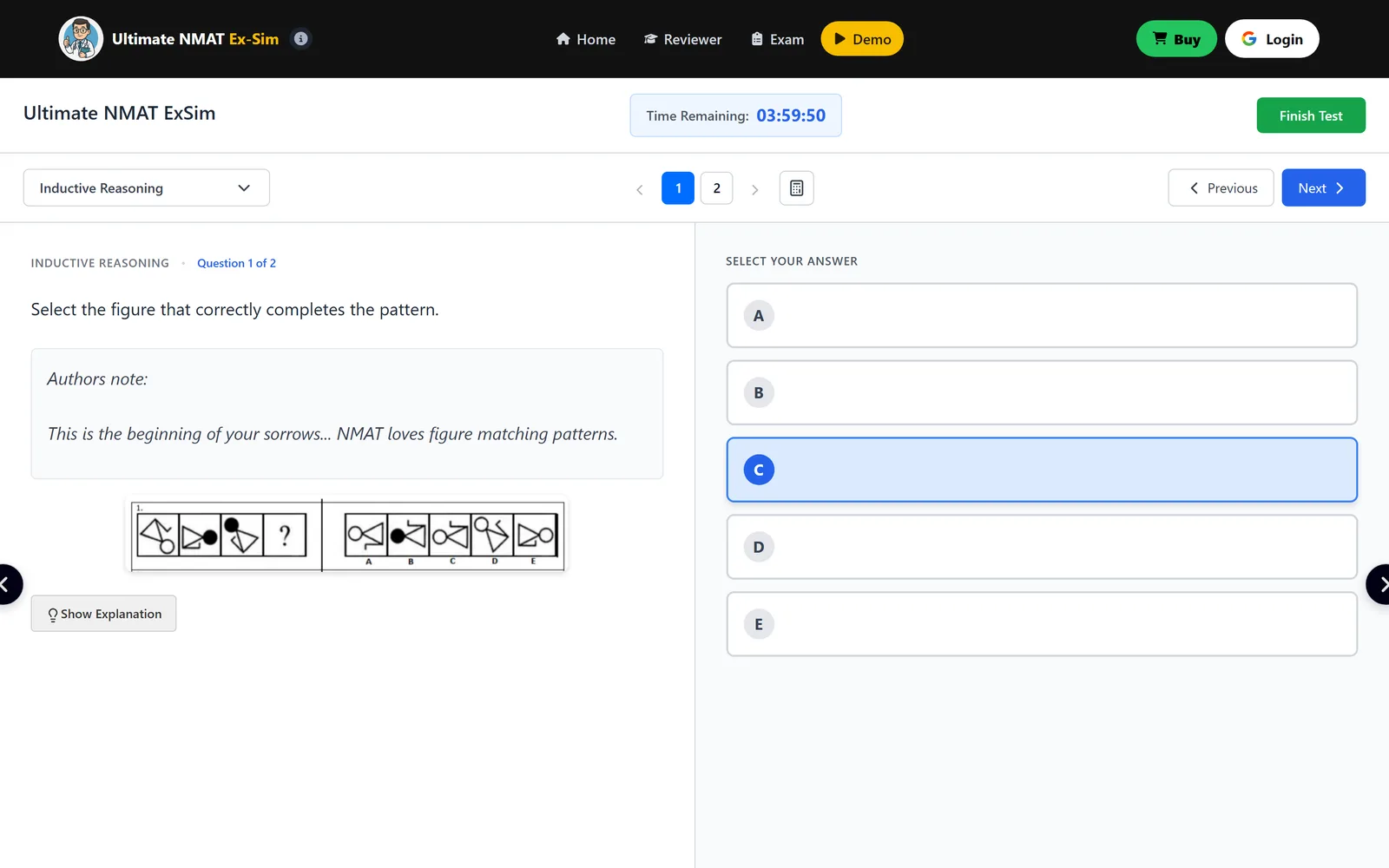
If a subtest has not moved, change the method rather than repeating the drill. For Quantitative, return to mental arithmetic using our no-calculator guide. For figure and series items, go back to the checklist in our Part 1 guide. For the sciences, review concepts first, then timed recall, as in our Part 2 guide.
Hold the pace targets steady: about 67.5 seconds an item in Part 1 and 45 seconds in Part 2. If you run out of time in one part, practise skipping. Mark a hard item, move on and return if time allows.
What should week two out look like?
In the second week out, sit your third full exam and rehearse your online setup in full. The proctored format makes this week the right time to find technical problems, while you still have days to fix them.
CEM's Test Day Instructions say that your webcam and microphone must remain on throughout the test. Do a complete run: sit in the room you plan to use, check the camera angle, lighting, microphone and internet connection, and close everything on the device that is not needed.
The same instructions list prohibited items, including phones, tablets, watches, notes and physical calculators, and say that scratch work is allowed only with authorised materials shown to the proctor on request. Read the current page rather than relying on memory, and do not assume ordinary paper and pens are acceptable.
Our guide to online NMAT rules and setup gives a full checklist. Do a short timed set with the camera on, so that being watched is familiar by test week.
What should test week look like?
Test week is a taper. Study about half your usual load, review your error log, and spend the saved energy on sleep, food and a settled setup. Skills you built over a month do not disappear in a few lighter days.
Early in the week, redo a small set of items you previously missed. Midweek, run a short timed set in each of your two weakest subtests. In the final two days, do no full exam. A full sitting takes about four hours and can leave you tired when you should be fresh.
The day before, check your device, charger, connection and room, and read the Test Day Instructions once more. Set out what you need, lay out your ID if CEM requires it, and prepare a plain meal for the next day. Then stop. A calm evening does more than another hour of drills.
On the day, log in early, follow the proctor's instructions and use the break between parts to rest. If nerves are your main worry, our guide to NMAT anxiety has a reset routine you can practise now.
How should you handle the days between full exams?
Between full exams, run short, focused sessions that repair one thing at a time, and keep a log of what each session fixed. The days between exams are where the percentile-relevant work happens, because a full exam only measures; repair is what changes the next result.
A workable weekday has three blocks. First, 40 minutes on the subtest that cost you most in the latest exam, using drills at full pace. Second, 30 minutes of explanations for every item you missed, written in your own words. Third, 20 minutes of mixed items from the subtests you are not repairing, so they stay warm.
Keep weekends for the long work: a full exam, then a calm review the next day. Do not stack an exam and its review on the same evening, because tired review misses the real cause of an error.
Track one number per exam that you can influence, such as the count of arithmetic slips or the items you left blank. If that number falls, your method is working. You can try timed items in all eight subtests in the free demo while you decide where to repair.
Frequently asked questions
Should I study the night before the NMAT?
Keep it very light, if you study at all. A short look at your error log or vocabulary list is fine, but a long session costs sleep and adds little. Check your setup, prepare what you need and go to bed on time. Rest before a four-hour online sitting is worth more than another set of drills.
Should I test my webcam setup before the NMAT?
Yes. CEM requires the webcam and microphone to stay on throughout, and the test is live-proctored, so rehearse once in the exact room and on the exact device you will use. Check lighting, camera angle, sound and connection, then leave everything in place until test day.
Should I take a full exam in the final week?
We suggest not. Take your last full exam about 10 to 14 days out, review it, and use the final week for light repair and rest. A full exam in the last two days can leave you tired and shaken by a score you have little time to act on.
Is it too late to improve in the last month?
No, but be realistic. A month will not rebuild a subject from scratch, yet it is enough to improve pace, fix repeated error types and lower avoidable mistakes. We cannot promise any particular percentile, because outcomes vary, so aim at steady, checkable gains in each practice exam.
Sources
From the publisher
Meet the NMAT clock here first.
Ultimate NMAT is an NMAT simulator: full-length practice exams and subtest drills in all eight NMAT subtests, sat on a clock, with an explanation behind the items instead of a bare answer key.
- 4,670 practice items in all eight NMAT subtests
- nine full-length practice exams (A to I), 2,320 items
- eight subject drill tracks of ten sets each, 2,350 items
- An interactive reviewer and simulation lab beside the question bank
Try the free NMAT simulator demo A short sample in all eight subtests. No account needed.
About this article
Written by the Ultimate NMAT editorial team, who build the Ultimate NMAT Ex-Sim. Exam facts are checked against the Center for Educational Measurement (CEM) test pages and the CHED issuances CEM cites, and every article lists its sources. How we write and check our articles.
First published .